
Change work is filed as a leftover ticket
“Write training” appears in sprint 6 because nobody estimated it when leaders said yes. By then the date is fixed.
Change management and Jira sprints
Jira sprints track engineering work items. Business change management—training, adoption, process redesign, communication—rarely has a home on that board. Precision Foundry connects the two: estimate both sides before a yes, then keep delivery on native boards or point Jira at the same thread if Atlassian is already the system of record.
For change managers, operations leads, and IT partners who watch sprints start before anyone counted the people who must work differently.
A usable connection includes
A Jira sprint is honest about developer capacity and silent about learner hours, job-aid design, backfill, and the first month of support. Change managers are asked to “align to the release” after the backlog is already full. Connecting those worlds is not a Jira workflow tweak. It is a gate that happens before sprint planning.
“Write training” appears in sprint 6 because nobody estimated it when leaders said yes. By then the date is fixed.
A launch email is not change management. Roles, procedures, and who stops their regular work never make it onto the board.
Custom fields can store a number. They do not force a separate business estimate next to technical size before capacity is committed.
Optional coexistence
The connection is the approved record: problem, people, both estimates, and a first-release boundary. Foundry holds that record. If engineering must sprint in Jira, the sprint should be a pointer to work that already includes change effort—not a place to discover it.
Do this after the request has a clear problem and affected roles—and before anyone treats a developer sprint plan as a commitment.
List roles, not a headcount guess. Separate daily users from reviewers and support. If you cannot name them, the project is not ready for a sprint.
Count design, delivery, learner time, backfill, and first-month support. Put that number on the same record as the build estimate.
Approve the outcome and the exclusions. Change tasks that were not in that yes become a later increment, not silent sprint scope.
Requirements, stories, and change tasks stay attached to the request. This is the frictionless path: one thread from intake through the sprint.
When Jira remains the system of record, create sprint items as pointers to the Foundry work. Do not paste “write training” as a new story with no source.
Visual proof
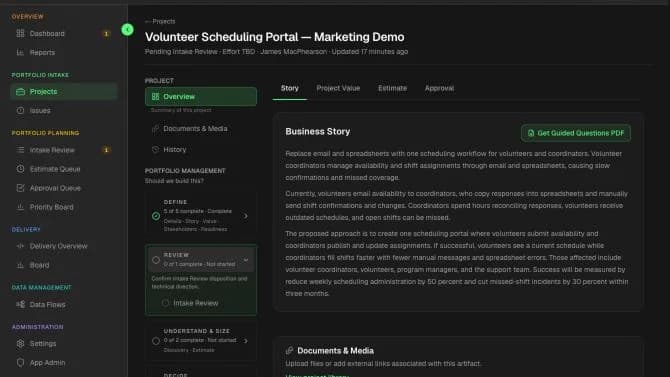
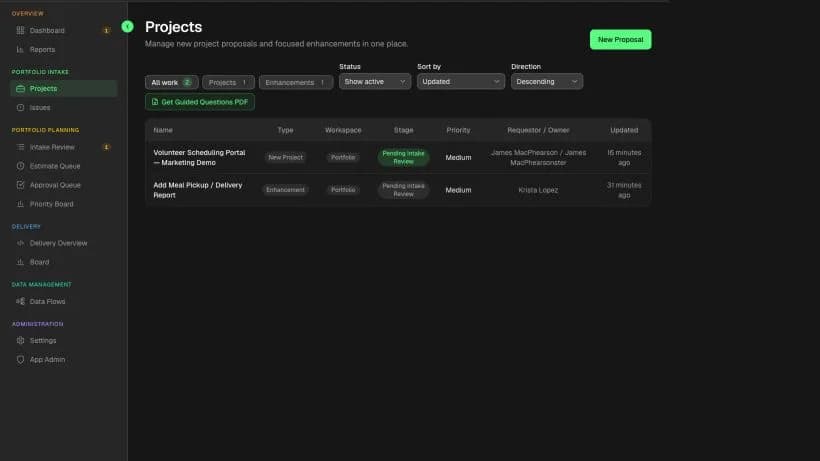
A Jira sprint is honest about developer capacity and silent about learner hours. Foundry records both estimates first, then the epic engineering opens already knows the adoption work.
Foundry submission
Jira-ready epic
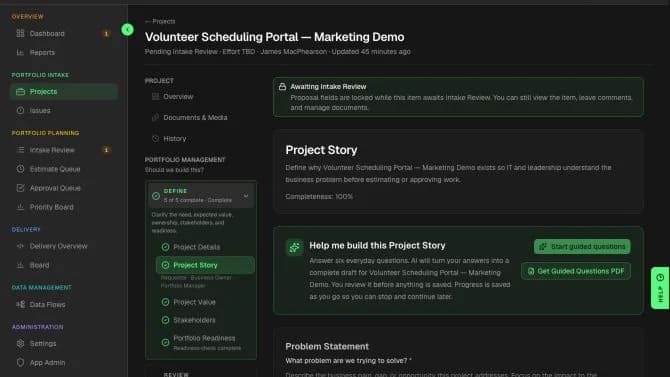
Jira-ready sprint epic
Pointer to the Foundry thread—not a paste of the intake form into a Jira description.
If engineering must sprint in Jira, create one Epic for the approved Foundry delivery record and paste the stable Foundry link into that Epic. Child stories and tasks can stay in Jira without separate Foundry links.
This is the manual handoff model. Foundry holds the living request. One Jira Epic carries the stable pointer; engineering manages its child work in Jira when Jira owns execution.
What the Jira epic should inherit—not retype
Jira epic field
Epic summary and reporter
What survives
The person closest to the problem stays visible
Jira epic field
Epic description as a pointer, not a rewrite
What survives
QA can open the original words
Jira epic field
Sprint commitment only after the recorded yes
What survives
Training and adoption are not dropped at the paste
Jira epic field
Linked acceptance / definition of done
What survives
Out-of-scope work does not appear as new tickets
Jira epic field
Child stories and tasks managed in Jira
What survives
Engineering derives child work from the reviewed requirements; each child does not need a separate Foundry link
| Foundry field | Jira epic field | What survives |
|---|---|---|
| Proposal name and requestor | Epic summary and reporter | The person closest to the problem stays visible |
| Business problem and first-release outcome | Epic description as a pointer, not a rewrite | QA can open the original words |
| Business and technical estimates | Sprint commitment only after the recorded yes | Training and adoption are not dropped at the paste |
| Named exclusions and constraints | Linked acceptance / definition of done | Out-of-scope work does not appear as new tickets |
| Reviewed business and functional requirements | Child stories and tasks managed in Jira | Engineering derives child work from the reviewed requirements; each child does not need a separate Foundry link |
Native delivery boards
Foundry’s delivery board is where change tasks sit next to build work without waiting for a Jira field to be invented. Teams on an Atlassian contract can still sprint in Jira. They should not discover adoption work there for the first time.
Request Private Alpha to run one software change through both estimates and a board that already expects training and adoption—not a Jira afterthought.
Common questions
Estimate training and adoption with the technical work, record a yes against a first-release boundary, and create sprint items only from that approved set. Precision Foundry holds the thread. Jira can remain the system of record if engineering already requires it.
A workflow can require a checklist. It does not produce a business estimate, name the roles who must learn the new work, or keep those answers attached through testing. The sprint then absorbs change as unplanned work.
Yes. That is optional coexistence. Foundry keeps the business thread and native boards. Engineering can sprint in Jira against pointers. Do not make the Jira description the only place adoption is written down.
After the yes, as part of the first-release plan—not after development has already committed dates. If training was invisible at approval, it is already late.
Private alpha is for the Business–IT gate and native delivery boards. You do not have to throw away an Atlassian contract to try it.
Request Private AlphaOptional cookies
We use optional technologies only with your choice. Strictly necessary cookies for sign-in and security always run. Cookie Policy