Optional coexistence

Keep your developers in Jira. Keep the chaos out of it.

Walled gardens want the whole company inside the developer backlog. If engineering is locked into a corporate Atlassian contract, you do not have to throw Jira away. Precision Foundry is the intake buffer in front of it: plain-language requests, both estimates, and a recorded yes. Jira can stay the work-item system of record. Foundry also has native delivery boards when you want the work to stay on the same thread.

For teams on an Atlassian contract who still need a Business–IT software gate—and are not ready to rip Jira out of engineering.

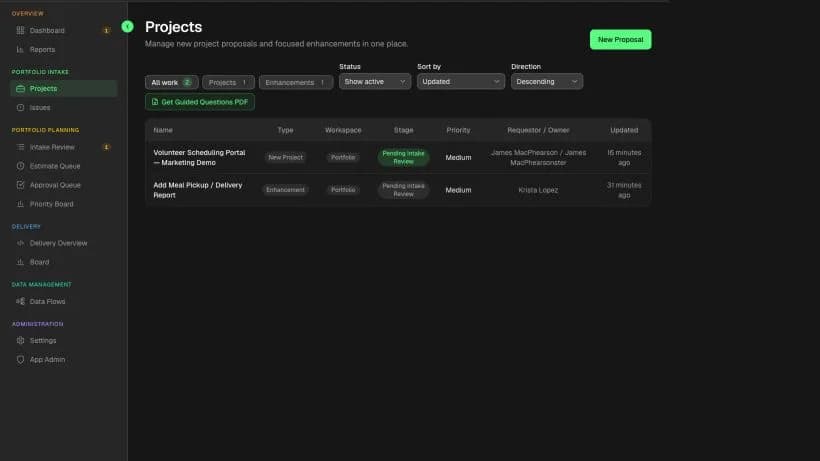
Precision Foundry project portfolio showing fictional Client Intake Portal and Volunteer Scheduling System requests awaiting intake review

Optional coexistence means

  • Jira can stay the work-item system of record
  • Unvalidated ideas stay out of the sprint board
  • Native boards are there if you want to stop copying

A corporate Jira contract is not the same as a software decision process

Atlassian is often already paid for. That does not mean a Jira work item is a business case, or that a sprint is the right place to discover who must change how they work. Teams either force intake into Jira fields or run a parallel spreadsheet. Neither gives leaders a yes they can stand behind.

01

The contract decides the tracker, not the gate

Engineering standardizes on Jira because the organization already bought it. Business still arrives with a vague ask, and the first ticket becomes the spec.

02

Custom fields are not dual estimates

A workflow can require a reviewer. It does not capture business effort—training, adoption, process change—next to technical size.

03

Copying later still loses the thread

If the only path after approval is a paste into Jira, QA inherits a paraphrase. Coexistence only works if Foundry stays the living request.

Optional coexistence

Foundry in front. Jira if you already require it.

This is not a rip-and-replace pitch. Foundry does the work Jira is a poor fit for: a software idea, guided discovery, separate business and IT estimates, and a recorded decision. After that yes, delivery can stay on Foundry’s board—or continue in Jira because that is already how engineering works.

Keep Jira when

  • The Atlassian contract is not going away this year
  • Engineering already reports, apps, and releases from Jira
  • Leaders will not approve a second work-item platform

Use Foundry as the filter when

  • The request is still a problem, not a defined work item
  • Business and IT must estimate both sides before capacity is spent
  • You want testers to verify the same thread the requestor wrote

Optional Coexistence Path: Filter the Request in Foundry Before Anyone Opens Jira

The filter is the product. The handoff is optional. Most teams should finish the gate in Foundry before anyone opens a Jira project.

  1. 1

    Capture the software change in Foundry

    Start with the business problem, the people affected, and the outcome that would make the change worth doing—not a Jira summary.

  2. 2

    Estimate both sides and record the yes

    Business effort and technical effort sit on one record. Leaders say yes, no, or not yet with that evidence.

  3. 3

    Plan delivery on Foundry’s boards

    Requirements, stories, and sprints stay attached to the request. This is the frictionless path when you are not required to copy.

  4. 4

    Keep Jira only if engineering already lives there

    If the contract requires Jira as the system of record, point work items at the Foundry thread. Do not paste the story into a new description.

Visual proof

From a Foundry submission to a clean Jira sprint epic

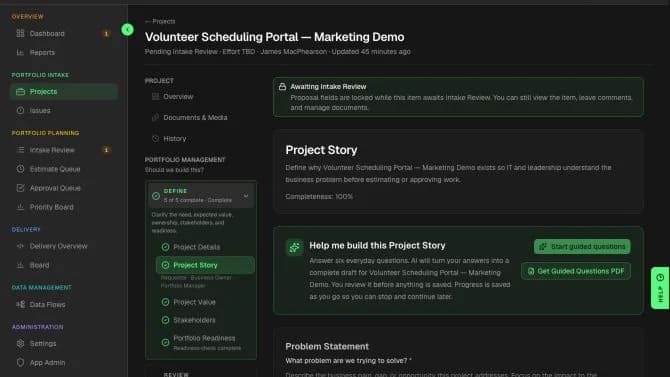
Teams searching for Jira alternatives or intake-form fixes need to see the handoff. The request stays structured in Foundry. The epic engineering opens is a pointer to that thread—not a flattened paste.

Foundry submission

Precision Foundry portfolio intake showing fictional Client Intake Portal and Volunteer Scheduling System submissions awaiting review
The request enters as a software proposal: problem, owner, stage, and priority—before anyone opens Jira.

Jira-ready epic

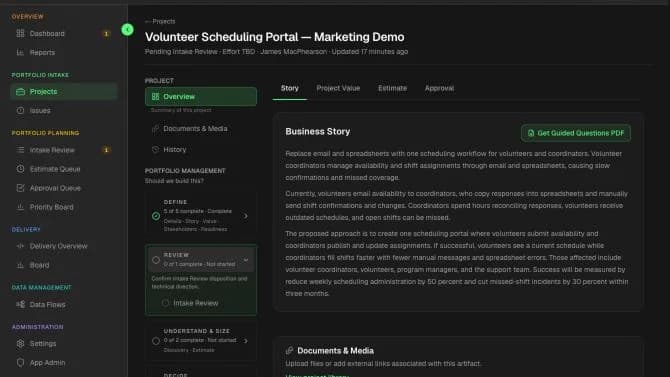
Precision Foundry requirements for a fictional Client Intake Portal, ready to become a Jira sprint epic without rewriting the intake
After the yes, reviewed requirements stay on the same record. A Jira epic can point here instead of flattening the story into Description.

Jira-ready sprint epic

Client Intake Portal

Pointer to the Foundry thread—not a paste of the intake form into a Jira description.

Epic name
Client Intake Portal
System of record
Foundry request (living thread)
Outcome
Measure first-six-month intake outcomes
First-release boundary
Approved services only; public status out
Estimates
Business effort and technical effort recorded before sprint planning
Child work
Stories derived from reviewed requirements

If engineering must sprint in Jira, create the epic as a pointer to this record. Do not copy the intake into Description.

What the Jira epic should inherit—not retype

This is the integration layer. Foundry holds the living request. The work item only needs a stable pointer plus the fields engineering already reports on.

What the Jira epic should inherit—not retype
Foundry fieldJira epic fieldWhat survives
Proposal name and requestorEpic summary and reporterThe person closest to the problem stays visible
Business problem and first-release outcomeEpic description as a pointer, not a rewriteQA can open the original words
Business and technical estimatesSprint commitment only after the recorded yesTraining and adoption are not dropped at the paste
Named exclusions and constraintsLinked acceptance / definition of doneOut-of-scope work does not appear as new tickets
Reviewed business and functional requirementsChild stories and tasksStories are derived from the thread, not paraphrased
Precision Foundry portfolio readiness screen for a fictional Client Intake Portal project

Native delivery boards

Native delivery boards so coexistence is a choice

Foundry is not an intake form that dumps work into Jira. After approval you already have a sprint board, testing, and release on the same record. That is what makes Jira optional: you can keep it, but you do not have to invent a second project to start building.

  • Requirements stay attached to the intake that funded them
  • Stories and tasks sit on a Foundry board the business can still read
  • Testing and release continue the same thread—QA is not opening a rewritten ticket
  • A Jira copy is a pointer, not the first time the request becomes official

Teams that are not ready to leave Jira still get a complete software path: gate, plan, and delivery. The waitlist is for the private alpha of that path—not a Jira plugin.

Common questions

Questions about optional coexistence

Can we use Precision Foundry if we are locked into Jira?+

Yes. That is optional coexistence. Foundry is the front-end filter for software change. Jira can remain the work-item system of record because the organization already requires it. You do not have to copy Foundry delivery into Jira unless that is already how engineering works.

Is Precision Foundry a Jira replacement?+

Not as Atlassian’s work-item platform. Foundry is for the Business–IT gate and then requirements through testing and release. If engineering already standardizes on Jira, keep it. Foundry’s boards exist so a handoff is optional, not required.

Do we have to connect Foundry to Jira on day one?+

No. The private alpha is Foundry itself: intake, estimates, the decision, and native boards. A later pointer into Jira is a policy choice, not the product’s starting requirement.

What happens to the business story if we keep Jira?+

It stays in Foundry. Work items should point at that thread. Pasting the intake into a Jira description is how the requestor’s context dies and QA verifies a paraphrase.

Keep Jira. Join the waitlist for the filter in front of it.

Private alpha is for the Business–IT gate and native delivery boards. You do not have to throw away an Atlassian contract to try it.

Join the private alpha waitlist