
Ideas arrive as solutions
Scoring a feature name hides the people, the current process, and the outcome that would make the change worth doing.
Jira Product Discovery alternatives
Teams shopping Jira Product Discovery alternatives usually want either better idea scoring or a path that stops ranked bets from becoming unvetted epics. Precision Foundry is in the second camp: a Business–IT software gate, dual estimates, then requirements, native boards, testing, and release—while Jira can stay the system of record if the contract already requires it.
For product and PMO partners evaluating Jira Product Discovery who still cannot leave an Atlassian contract—and need more than idea scoring.
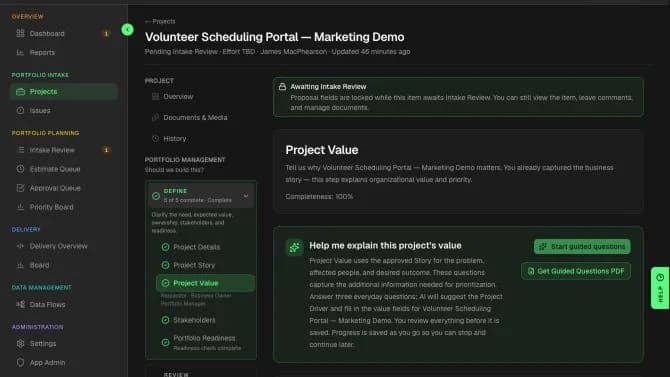
A useful JPD alternative should
Jira Product Discovery is built to collect ideas, prioritize them, and connect a roadmap to Jira work items. That helps a product team rank bets. It does not replace guided discovery, separate business and technical estimates, or a recorded investment decision. Teams that buy JPD still open Jira with a slogan.
Scoring a feature name hides the people, the current process, and the outcome that would make the change worth doing.
JPD produces an idea, an impact-versus-effort score, a roadmap slot, and a linked Jira issue. It does not produce a questionnaire, a business estimate, an IT estimate, or a recorded yes. A ranked idea can still become an epic with none of those attached.
JPD is designed to feed Jira. If you are locked into that path, you still need a filter that does not treat the first work item as the spec.
Optional coexistence
Most Jira Product Discovery alternatives ask you to move ideas into another product-management cloud. Foundry’s offer is narrower: software change from story through release. Keep Jira for work items if engineering already lives there. Use Foundry when the request is still a business problem that needs a yes.
You do not have to rip out JPD to try the gate. Use Foundry for software requests that still need a story. Leave idea scoring where it already works.
If JPD is collecting raw ideas, leave that funnel. Foundry starts when a software change needs a business story, not a score.
Discovery, business effort, technical effort, and a recorded yes happen before anyone treats a Jira work item as the spec.
Requirements, sprints, testing, and release stay on the same thread. That is the frictionless path this alternative is built for.
When the contract requires Jira as the system of record, create work items as pointers—not a rewrite of the Foundry record.
Visual proof
JPD can rank an idea. It does not produce a Jira-ready sprint epic with both estimates, exclusions, and the requestor’s words still attached. Foundry is the filter that does.
Foundry submission
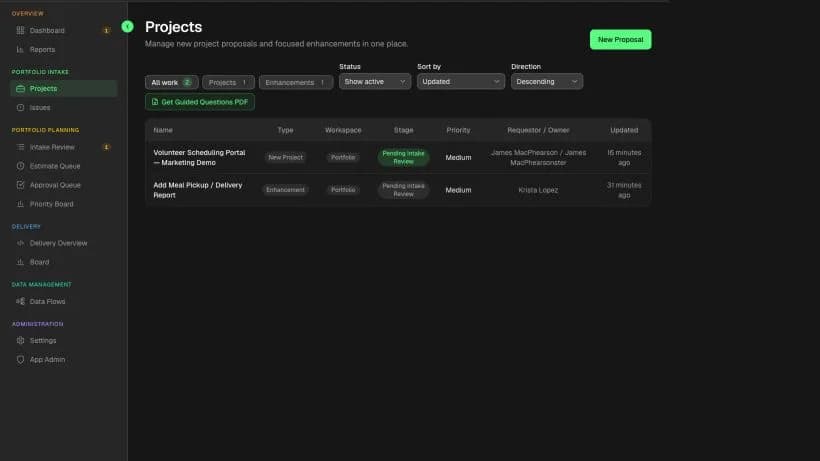
Jira-ready epic
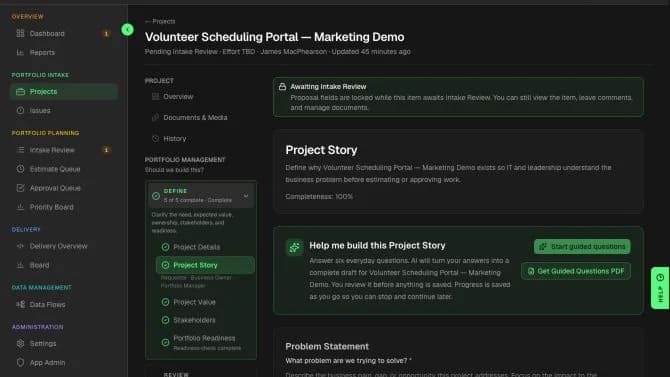
Jira-ready sprint epic
Pointer to the Foundry thread—not a paste of the intake form into a Jira description.
If engineering must sprint in Jira, create one Epic for the approved Foundry delivery record and paste the stable Foundry link into that Epic. Child stories and tasks can stay in Jira without separate Foundry links.
This is the manual handoff model. Foundry holds the living request. One Jira Epic carries the stable pointer; engineering manages its child work in Jira when Jira owns execution.
What the Jira epic should inherit—not retype
Jira epic field
Epic summary and reporter
What survives
The person closest to the problem stays visible
Jira epic field
Epic description as a pointer, not a rewrite
What survives
QA can open the original words
Jira epic field
Sprint commitment only after the recorded yes
What survives
Training and adoption are not dropped at the paste
Jira epic field
Linked acceptance / definition of done
What survives
Out-of-scope work does not appear as new tickets
Jira epic field
Child stories and tasks managed in Jira
What survives
Engineering derives child work from the reviewed requirements; each child does not need a separate Foundry link
| Foundry field | Jira epic field | What survives |
|---|---|---|
| Proposal name and requestor | Epic summary and reporter | The person closest to the problem stays visible |
| Business problem and first-release outcome | Epic description as a pointer, not a rewrite | QA can open the original words |
| Business and technical estimates | Sprint commitment only after the recorded yes | Training and adoption are not dropped at the paste |
| Named exclusions and constraints | Linked acceptance / definition of done | Out-of-scope work does not appear as new tickets |
| Reviewed business and functional requirements | Child stories and tasks managed in Jira | Engineering derives child work from the reviewed requirements; each child does not need a separate Foundry link |
Native delivery boards
Jira Product Discovery ends at Jira delivery. Foundry continues through a sprint board, testing, and release without leaving the product. That is why teams join the waitlist: they want the gate and the board, even if Jira remains nearby.
Request Private Alpha to walk one software request through Foundry’s gate and native boards—without committing to throw Jira away.
Common questions
Shortlist by job, not by feature count. Stay with JPD—or a peer idea-scoring tool—when the gap is portals, impact scores, and published roadmaps. Shortlist Precision Foundry when the gap is a scored idea that still lacks a questionnaire, dual estimates, and a recorded software yes.
Yes for teams evaluating alternatives because epics still start without a business case. No if you only need a better idea portal or scoring matrix—Foundry is not that product category.
Yes. Optional coexistence is the campaign: Foundry filters the request; Jira remains if the organization already requires it. Native Foundry boards mean you do not have to copy approved work unless that is already how engineering works.
No—and that should not be the evaluation criterion. Ask whether the alternative produces dual estimates and a recorded yes before a ranked bet becomes an epic. Roadmaps can stay in JPD while that gate runs elsewhere.
Use a buyer checklist: Does the tool score ideas or approve software investments? Does it produce business effort next to technical effort? Can Jira remain after a yes? For the feature-by-feature matrix against JPD objects, see Precision Foundry vs Jira Product Discovery.
Private alpha is for the Business–IT gate and native delivery boards. You do not have to throw away an Atlassian contract to try it.
Request Private AlphaOptional cookies
We use optional technologies only with your choice. Strictly necessary cookies for sign-in and security always run. Cookie Policy