
The wrong traffic, the wrong projects
A PM listing attracts campaign calendars and hiring pipelines. An SDM listing attracts software requests that need a story, estimates, and a delivery plan.
Software delivery management
Software delivery management means helping teams turn a software idea into a clear, approved plan. Precision Foundry does that in one product: the request, estimates from both sides, approval, requirements, delivery board, testing, and release. It is the wrong tool for campaigns, hiring queues, or office workflows.
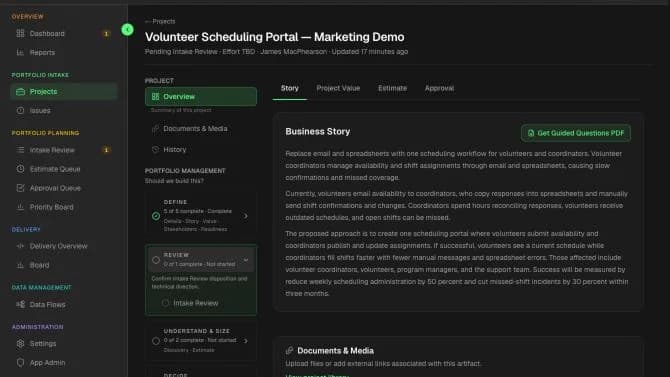
An SDM ecosystem replaces
Generic project-management software is built for marketing events, HR queues, and office checklists. A software delivery management ecosystem only accepts software change—and keeps that change connected from the first request through release.
Comparing products rather than defining the category? Review software delivery management tools by starting point, lifecycle coverage, and operating model.
A PM listing attracts campaign calendars and hiring pipelines. An SDM listing attracts software requests that need a story, estimates, and a delivery plan.
When discovery lives in documents and execution lives in a tracker, the approved boundary is already gone by sprint planning.
Tickets get created to discover the work. An SDM path records the problem, both estimates, and the yes before a sprint board opens.
Software delivery management is the practice of carrying a software change from the original business request through discovery, estimation, approval, requirements, delivery, testing, and release. The defining feature is continuity: the reason the work was funded remains connected to the scope, execution record, acceptance evidence, and release decision.
A software delivery management platform gives Business, Product, IT, Engineering, and QA one governed path for software change. It should connect intake, clarification, separate Business and technical estimates, prioritization, approval, requirements, sprint work, acceptance criteria, testing evidence, and release readiness instead of requiring each stage to reconstruct the request in another tool.
A software delivery management system connects decisions and evidence: who requested the change, what outcome matters, what was approved, which requirements and stories implement it, what the team delivered, whether the acceptance criteria passed, and why the release was authorized. A technical software delivery system usually focuses on source control, builds, automated tests, deployment, security, and observability. Precision Foundry complements those CI/CD capabilities rather than replacing them.
General project-management software can coordinate campaigns, hiring, events, and office work. Software delivery management is narrower: it governs software change and preserves traceability from the business problem to requirements, delivery work, testing, and release. That narrower boundary keeps unrelated work from defining the software lifecycle.
Application lifecycle management can provide deep enterprise requirements, quality, compliance, and portfolio controls. DevOps and CI/CD automate how code is built, tested, secured, deployed, and observed. Software delivery management connects the business decision and delivery record around that technical execution. The categories can work together; they do not have to replace one another.
Start with one real software request and follow it end to end. Check whether the platform preserves the original problem, records Business and IT estimates separately, makes the approval boundary explicit, turns reviewed requirements into delivery work, carries acceptance criteria into testing, and retains evidence for the release decision. Then count the integrations, administrators, and companion products required to keep that record intact.
Software delivery management is the connected lifecycle—not a stack of office tools with a software label.
Describe the system problem, the people affected, and the outcome that would make the change worth doing.
Answer the missing questions, estimate both sides of the effort, prioritize against other software work, and record a yes, no, or not yet.
Requirements, stories, the sprint board, testing, and release stay attached to the decision that created them.
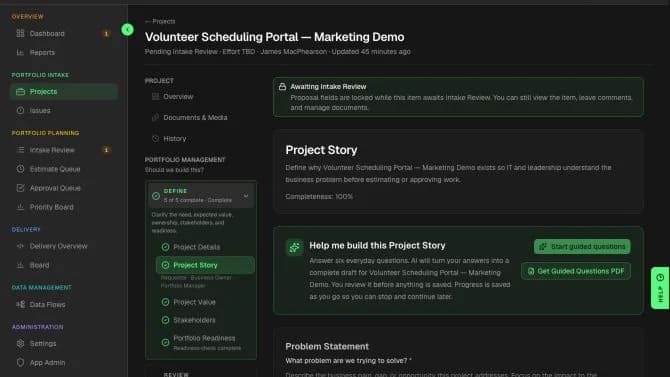
In the product
Discovery is not a separate document pile. The same request that earned a yes becomes the requirements and sprint work.
Results
Teams looking for a campaign tracker or an HR queue should leave. Teams looking for lightweight software delivery management should find one product that is easy to adopt and holds the request through release.
Common questions
Software delivery management is the practice of governing a software change from the request through requirements, delivery, testing, and release. An SDM ecosystem keeps those stages in one product so the approved boundary survives sprint planning.
No. Project management tooling is built for any kind of coordinated work. Precision Foundry only fits software change. Campaigns, events, hiring, and office workflows belong in a general team tracker.
Jira tracks work items. Asana manages team work of many kinds. An SDM ecosystem starts before those tools have a trustworthy item: the business story, dual estimates, and a recorded software decision—then continues through requirements, sprints, testing, and release.
On G2 and Capterra, tag Precision Foundry under Project Intake Software first, then Requirements Gathering Software, Agile Delivery Environments, and Project Prioritization Tools. Do not file it under Project Management or Work Management.
Follow a software change from the request through approval, the board, testing, and release—without an office-work tracker.
Request Private AlphaOptional cookies
We use optional technologies only with your choice. Strictly necessary cookies for sign-in and security always run. Cookie Policy