
Requirements that never reach the board
Carry reviewed answers into epics, stories, and acceptance criteria instead of asking the team to reconstruct the request in sprint planning.
Unified requirements and sprint tracker
Precision Foundry is a unified requirements and sprint tracker for software change. The questions that defined the system become the stories on the board—without rewriting the project in a second tool.
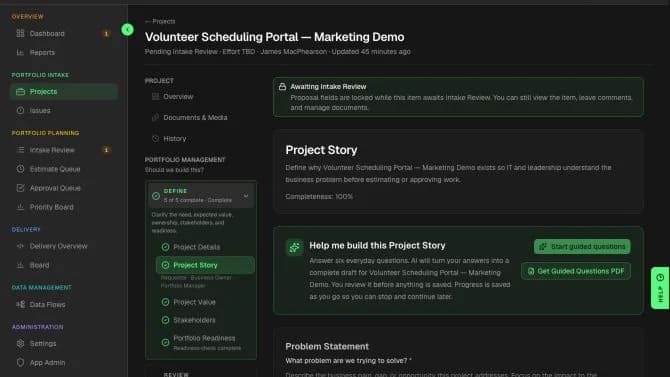
A unified tracker replaces
When requirements live in a wiki and sprints live in a tracker, the first-release boundary is already gone. A unified requirements and sprint tracker keeps the approved understanding attached to the work.
Carry reviewed answers into epics, stories, and acceptance criteria instead of asking the team to reconstruct the request in sprint planning.
Open the board only after the software change has a story, dual estimates, and a recorded yes. New ideas become a later increment, not silent ticket sprawl.
A general project board will schedule a gala as easily as a payroll integration. This tracker only fits software delivery.
The same product gathers the questions, turns them into delivery artifacts, and runs the sprint—so testers can still see why a story exists.
Use the intake as context. Answer focused questions about people, rules, data, integrations, and what must stay unchanged.
Convert the agreed understanding into requirements, epics, stories, acceptance criteria, and tasks the delivery team can pick up.
The delivery board and sprints stay connected to the original request, then continue into testing and release.
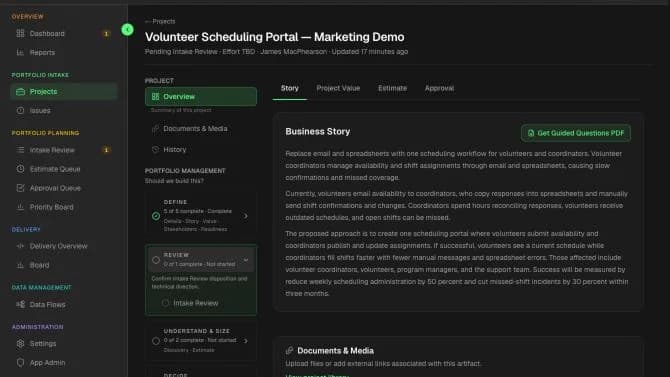
In the product
Value, effort, and the first-release boundary sit next to the work the team will actually run.
Results
A unified tracker makes it possible to explain why a story exists, what was excluded from the first release, and whether the delivered result matches the approved outcome.
Common questions
It is a software-delivery product that keeps requirements gathering and sprint execution in one system. Stories and tasks remain traceable to the reviewed answers and the approval that created them.
Not for the Foundry path. After approval, Foundry has requirements, a sprint board, testing, and release. Keep Jira only if engineering already standardizes on it.
You can create the item, but Foundry will treat it as a software change. A campaign calendar belongs in a general team tracker, not a unified requirements and sprint tracker.
A project management board organizes owners and dates for any kind of work. This tracker only accepts software work that has requirements, acceptance criteria, and a delivery plan.
See how a unified requirements and sprint tracker keeps the approved answers attached to the board.
Request Private AlphaOptional cookies
We use optional technologies only with your choice. Strictly necessary cookies for sign-in and security always run. Cookie Policy