
Each role owns a different document
The charter lives in a slide deck. Requirements live in Confluence. Work lives in the tracker. None of those files is obligated to stay in sync, so they do not.
Requirement drift
Requirement drift starts when the product manager’s document, the developer’s ticket, and the tester’s checklist become three different stories. Stop it by keeping one data thread from intake through the release the QA tester verifies.
For product managers, engineering leads, and QA leads who keep rediscovering that “complete request,” “ready to test,” and “what the business asked for” no longer match.
Requirement drift is happening when
Product managers and developers rarely disagree on purpose. They disagree because each role is looking at a different artifact. The business user wrote an intake. The PM summarized it into a brief. Developers sliced that brief into tickets. QA wrote cases from the tickets. Every rewrite drops a constraint, invents a detail, or quietly changes what “done” means. Meetings cannot repair a process that keeps photocopying the request.
The charter lives in a slide deck. Requirements live in Confluence. Work lives in the tracker. None of those files is obligated to stay in sync, so they do not.
A hallway yes, a Slack thread, or a standup clarification becomes the real requirement. The written record still says the old thing.
If testers only see acceptance criteria typed at sprint planning, they cannot catch that the build solved a different problem than intake described.
Stopping requirement drift between product managers and developers is not a better standup. It is a rule: the requestor’s answers remain the source, and every story, estimate, and test traces back to those answers. New decisions update the thread. They do not start a second document.
The business user writes software project intake once. Product managers and developers should read that record—not a rewritten brief.
Keep reviewed answers in requirements gathering software so stories, estimates, and QA trace to the same thread instead of three copied documents.
If a hallway decision changes behavior, put it back on the same requirements gathering software record the same day. A second spec is how drift starts.
Intake must name the current problem, the people affected, and the first-release outcome. Feature lists are not a substitute.
“Staff can submit a complete client request and see its status” can drift. “Complete” has to mean named fields, named reviewers, and named exclusions. If the PM and the tech lead cannot point at the same outcome sentence, do not open a backlog yet.
Discovery questions should attach to the intake. Do not export a clean spec that then becomes the only thing developers read.
When a PM rewrites intake into a “clearer” document, they become the translator. Developers will implement the translation. The original constraint—“cannot launch during fall registration,” “payment vendor stays”—is what usually falls out.
A story without a parent requirement is how quiet reinterpretation enters the sprint.
If a developer needs a rule that is not on the record, the missing answer is the work—not a clever ticket title. Orphan stories are requirement drift with a Jira key.
If the team agrees “status does not email the client in v1,” that sentence belongs on the requirement, not only in chat.
The PM’s job is not to remember the decision. It is to make the decision visible to the next person who was not in the room—including the tester who joins two sprints later. An edit to the source thread also needs a dated history and a signal to developers already in the sprint, so the requirement cannot shift under them in silence.
Acceptance checks should open the same intake and requirement answers the business user created.
That is the test for whether drift stopped. If a QA tester cannot see what the requestor wrote, they are testing the development team’s memory. Pass/fail then measures the rewrite, not the request.
Practical template
Walk this before the first sprint, then again before QA starts. If a row fails, the documents have already diverged. The examples use a fictional client intake change.
Requirement-drift checklist for PM and engineering
What drift looks like
PMs optimize for the stakeholder who spoke last. Developers optimize for the ticket that is most specific.
What “still aligned” looks like
Staff submit a complete request and see status. Public self-service is out of scope. Both sides can quote that sentence.
What drift looks like
An unwritten “not now” becomes an implied “probably in this build.”
What “still aligned” looks like
No historical import, no mobile app, no client-facing email. The exclusion list sits next to the outcome.
What drift looks like
The word sounds agreed and is almost never defined the same way twice.
What “still aligned” looks like
Complete means the eight required fields, a department owner, and a file attachment. “Looks finished” is not a rule.
What drift looks like
Developers will fill silence with a reasonable guess. That guess is a new requirement.
What “still aligned” looks like
Legal has not confirmed retention wording. Launch uses the current policy until they do. The gap is visible.
What drift looks like
A story invented in refinement is how the PM’s document and the board diverge.
What “still aligned” looks like
“Notify supervisor on submit” traces to a reviewed notification answer. “Add an export” is parked.
What drift looks like
Chat is a faster record than the spec, so it becomes the real spec.
What “still aligned” looks like
The “no client email in v1” decision is on the requirement the same day, with the person’s name, a dated history, and a review flag on work already in flight.
What drift looks like
If testers only see ticket text, they cannot catch a rewritten problem.
What “still aligned” looks like
The tester reads the requestor’s outcome and the reviewed answers, then checks the build against those—not against a summary the PM typed at planning.
| Check | What drift looks like | What “still aligned” looks like |
|---|---|---|
| One outcome sentence | PMs optimize for the stakeholder who spoke last. Developers optimize for the ticket that is most specific. | Staff submit a complete request and see status. Public self-service is out of scope. Both sides can quote that sentence. |
| Named exclusions | An unwritten “not now” becomes an implied “probably in this build.” | No historical import, no mobile app, no client-facing email. The exclusion list sits next to the outcome. |
| Shared definition of “complete” | The word sounds agreed and is almost never defined the same way twice. | Complete means the eight required fields, a department owner, and a file attachment. “Looks finished” is not a rule. |
| Open questions listed, not assumed | Developers will fill silence with a reasonable guess. That guess is a new requirement. | Legal has not confirmed retention wording. Launch uses the current policy until they do. The gap is visible. |
| Stories map to reviewed answers | A story invented in refinement is how the PM’s document and the board diverge. | “Notify supervisor on submit” traces to a reviewed notification answer. “Add an export” is parked. |
| Decisions update the source | Chat is a faster record than the spec, so it becomes the real spec. | The “no client email in v1” decision is on the requirement the same day, with the person’s name, a dated history, and a review flag on work already in flight. |
| QA opens the intake thread | If testers only see ticket text, they cannot catch a rewritten problem. | The tester reads the requestor’s outcome and the reviewed answers, then checks the build against those—not against a summary the PM typed at planning. |
Worked example
A fictional Client Intake Portal is approved so staff can submit a complete request and see status. Before release, the PM, the developers, and QA are no longer talking about the same product.
Where “complete request” split into three projects
What it described
Staff submit a complete request and see its status. Public self-service is later.
What it described
A polished status page and “fewer emails to the director”
What it described
A status field plus an optional public link, because the brief mentioned polish
What it described
Tickets that say “user can view status”—no definition of complete, no exclusion of public access
What it described
Three artifacts, three products. The requestor’s constraint never reached the tester.
What it described
Put “complete,” “staff-only,” and “no public link” back on the source. Rework the story that invented the link.
| Artifact | What it described |
|---|---|
| What intake said | Staff submit a complete request and see its status. Public self-service is later. |
| What the PM brief emphasized | A polished status page and “fewer emails to the director” |
| What developers built | A status field plus an optional public link, because the brief mentioned polish |
| What QA was given | Tickets that say “user can view status”—no definition of complete, no exclusion of public access |
| The drift | Three artifacts, three products. The requestor’s constraint never reached the tester. |
| The correction | Put “complete,” “staff-only,” and “no public link” back on the source. Rework the story that invented the link. |
Nobody was careless. Each role did a faithful job on the document they were handed. The failure was creating those documents by copying. Alignment returns when the tester, the developer, and the PM can open the same answers the business user wrote.
What intake said vs. what developers built
What developers built
A status field; “complete” was never turned into a rule
What developers built
An optional public link, because the PM brief said “polish”
What developers built
Tickets that said “user can view status”—no audience, no exclusions
What developers built
QA received no definition of done, so they tested the rewrite
| What intake said | What developers built |
|---|---|
| Staff submit a complete request and see its status | A status field; “complete” was never turned into a rule |
| Public self-service is later | An optional public link, because the PM brief said “polish” |
| Staff-only access, with named reviewers | Tickets that said “user can view status”—no audience, no exclusions |
| Required fields and a department owner | QA received no definition of done, so they tested the rewrite |
A rewrite feels like progress. It is how the requestor’s words become optional. Keep the intake visible and edit it, or you have already started a second project.
Chat is fine for speed. It is a poor system of record. If the decision is not on the requirement by the end of the day, the next person will not know it happened.
Criteria typed from what people recall will match the conversation, not the intake. Pull them from reviewed answers, or admit the answers are missing.
If testers cannot see the original request, they can only confirm the build matches development’s interpretation. That is how a wrong product ships with a green board.
In Precision Foundry
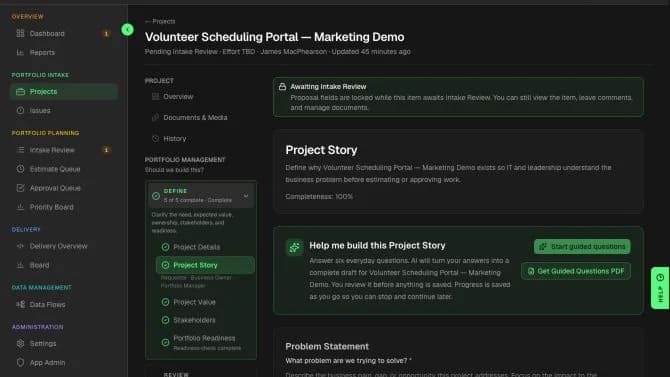
Precision Foundry is built so the QA tester verifying a release is looking at the exact same data thread the business user created during intake. The PM does not export a new brief to start development. Developers do not inherit a paraphrase. Testers do not invent the expected result from ticket text.
Common questions
Keep one source for the problem, the first-release outcome, and the reviewed answers. Trace stories to those answers. Put new decisions back on that record the same day. Have QA verify against the original thread, not a ticket written from memory.
Requirement drift is when the product the team ships no longer matches the request that was approved—because each handoff rewrote the story. It shows up as extra features, missing constraints, and testers who cannot tell what “done” was supposed to mean.
Scope creep adds unapproved work. Requirement drift changes the meaning of work that was already approved. You can freeze scope and still drift if PM, developers, and QA are reading different documents.
Neither should own a private copy. The business user created the intake; the PM keeps answers current; developers and QA read and update the same record. Ownership of a separate spec is how drift starts.
Precision Foundry keeps this guide attached to the request so the template does not live in a forgotten doc.
Request Private AlphaOptional cookies
We use optional technologies only with your choice. Strictly necessary cookies for sign-in and security always run. Cookie Policy