
The Traditional PMO Way
Heavy jargon: Gantt charts, RACI matrices, critical paths, and resource utilization charts.
The Precision Foundry Way
Everyday language: problem statement, people affected, reachable owner, and simple constraints.
Software project intake
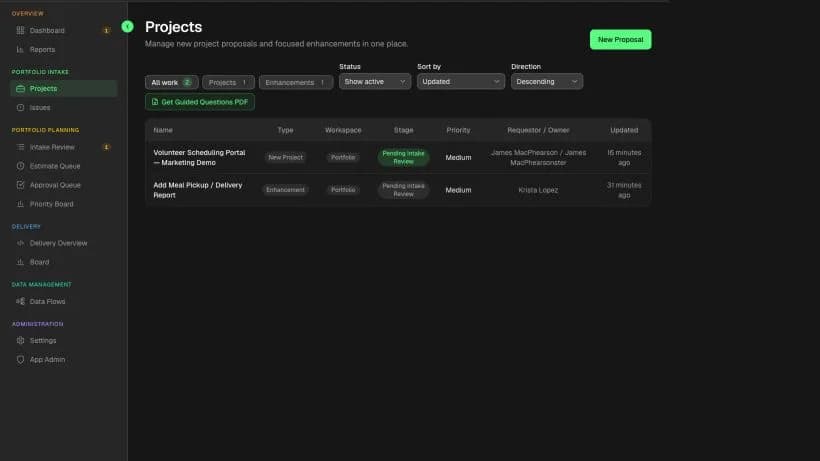
You know your business. A BA facilitates one shared software request in everyday language so the original problem reaches Intake Review intact. Early IT Triage then recommends the right discovery path before anyone treats the request as an approved project.
Not ready for the waitlist? Download the 4-page Anti-PMO Playbook
A complete software project intake replaces
Enterprise tools assume you have a certified Agile project manager to translate every handoff. Precision Foundry keeps the person closest to the work as the source while a BA facilitates one shared record in everyday language. IT then adds technical screening without replacing the business account.
The Traditional PMO Way
Heavy jargon: Gantt charts, RACI matrices, critical paths, and resource utilization charts.
The Precision Foundry Way
Everyday language: problem statement, people affected, reachable owner, and simple constraints.
The Traditional PMO Way
The translator tax: a dedicated PM sits in meetings to turn business language into tickets.
The Precision Foundry Way
The intelligent firewall: guided, plain-language questions extract clear constraints from day one.
The Traditional PMO Way
Process for process’s sake: hours spent updating spreadsheets and slide decks for a steering committee.
The Precision Foundry Way
Living evidence records: the original request becomes requirements, testing, and delivery on the same thread.
The Traditional PMO Way
The Precision Foundry Way
Heavy jargon: Gantt charts, RACI matrices, critical paths, and resource utilization charts.
Everyday language: problem statement, people affected, reachable owner, and simple constraints.
The translator tax: a dedicated PM sits in meetings to turn business language into tickets.
The intelligent firewall: guided, plain-language questions extract clear constraints from day one.
Process for process’s sake: hours spent updating spreadsheets and slide decks for a steering committee.
Living evidence records: the original request becomes requirements, testing, and delivery on the same thread.
Everyday language
Stakeholders describe what’s broken in their own words. Guided questions extract the problem, the people affected, and a reachable owner—without a Gantt chart or a RACI matrix.
Getting the business side and the tech side to agree on the real workload before anyone starts coding. People cost and code cost sit on the same card.
Pass clean, pre-validated scope to the people who build. The original request stays on the same thread through requirements, testing, and delivery.
Most submission forms collect a title, a deadline, and a requested system. Reviewers then book meetings to recover the problem the form never asked for. Software project intake should make the request complete—not invent the build, and not require a PMO to translate it.
Teams comparing products for that front door usually start with project intake software. This page is the software-only intake workflow—not the mixed PMO portal category page.
Capture the current situation, the people who feel the pain, a reachable owner, timing windows, and known limits in one request.
Ask what is broken and who is affected before the form invites a vendor name, an architecture, or a feature list.
Identify who submitted the request and who can answer follow-up questions while the story is still fresh.
The complete request enters this governed path: Intake Review and IT Triage → discovery-path recommendation → Discovery Questions → Business and IT estimates → investment approval → delivery → outcome review. Intake owns the request; it does not pretend that the later approval has already happened.
You know your business. Software project intake does not require a degree in Agile project management. The job is to make the request understandable. Discovery questions, scoring, and delivery sequencing belong later.
Start with the current process, the people involved, and why the existing path is not good enough—in everyday words.
Attach a reachable business owner, known timing windows, vendors that cannot move, and policies that already apply.
Give Intake Review and IT Triage one submission instead of asking the requestor to repeat the story in email, chat, and a kickoff.
In the product
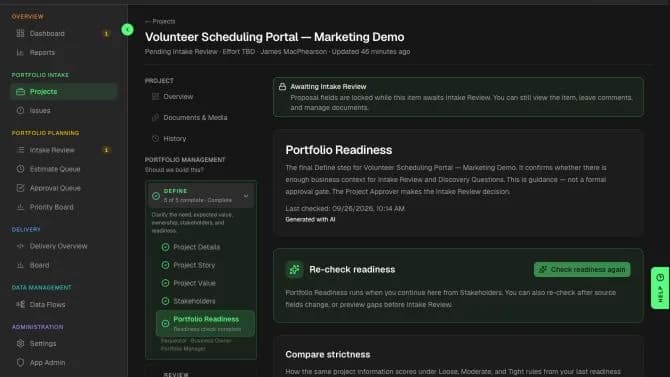
Portfolio Readiness checks whether the shared request is understandable before Intake Review. It provides guidance without replacing the Approver’s decision.
Results
When software project intake is complete, a stranger can name the problem, the people, the owner, and the hard limits. That record moves into Intake Review and early IT Triage—not directly into approval, a charter, or a backlog.
Common questions
Software project intake is how an organization collects and reviews a request for new software or a meaningful change. A useful submission explains the current problem, the people affected, a reachable owner, timing, and known constraints. It is not a project plan and it is not a score.
The person closest to the broken process supplies the facts. A BA can facilitate the shared request and later discovery questions without rewriting the source account. The business owner remains reachable for follow-up; IT adds technical context during Intake Review and discovery.
No. A complete submission starts with what is happening today and who hurts. Naming a vendor or a feature list too early hides the problem and makes requests incomparable.
Portfolio Readiness checks the submission and Intake Review considers its disposition. An IT Owner confirms the technical impact, flags any security, vendor, data, or architecture reviews, and recommends Standard Discovery, Lightweight Discovery, Existing Solution Review, or Not an IT Project. The Approver may then mark it Ready for Discovery; investment approval comes later, after discovery and both estimates.
Yes—for software project intake. A requestor submits a complete request in everyday language: what happens today, who is affected, a reachable owner, and known limits. A software intake tool here is that submission, not a ticket form and not a project plan.
Software project intake only accepts a system change: a complete request with the current process, affected people, owner, and limits. Campaigns, events, and office workflows belong in a general work tracker—not this front door.
The best process is the one that does not need a project manager to translate it. Start with a guided submission—not another intake sync.
Request Private AlphaOptional cookies
We use optional technologies only with your choice. Strictly necessary cookies for sign-in and security always run. Cookie Policy