Anti-PMO playbook

The Anti-PMO Playbook: How to Structure Software Intake with Zero Project Managers

A playbook for founders and VPs of engineering who keep teams lean on purpose. Structure software intake around the person closest to the work: a problem, the people affected, a reachable owner, and known constraints. No charter. No translator. No project office.

For founders and VPs of engineering who are intentionally keeping teams lean—and refuse to hire a project office to translate the work.

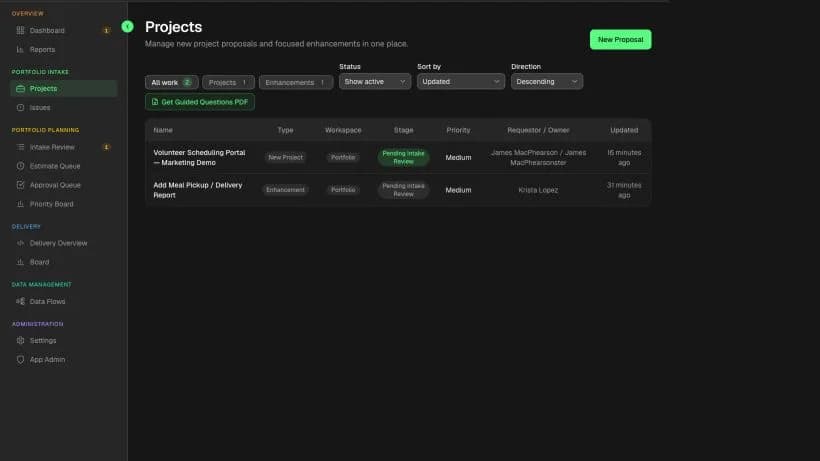
Precision Foundry intake portfolio showing fictional software requests awaiting review without a project office

A zero-PM intake structure names

  • Who submits: the person closest to the broken process
  • What “ready” means: a stranger can understand the story
  • What comes later: questions, estimates, and a recorded yes

Page 1

The Anti-PMO Playbook

When did building great software require a dictionary of project management acronyms? Somewhere along the way, we let complex ticketing systems, steering committees, and endless alignment meetings stand between a business need and a finished line of code. If your organization doesn't have a massive PMO to police your backlog, your software intake quickly turns into total chaos. This playbook gives you the exact framework to structure your requests using plain text, keeping your backlog clean and your developers focused entirely on building.

idea -> everyday language -> structured scope
no acronyms, no steering deck, no translator
intake stays off the sprint board until it is ready

Page 2

Rule #1: Separate the Chaos from the Backlog

Letting non-technical managers drop unvalidated ideas directly onto an engineering delivery board kills developer velocity. Keep a distinct Intake Layer completely separate from the Sprint Backlog. Chaos belongs in intake. The board only receives work that already survived a yes.

  1. The Walled-Garden Chaos
  2. Email / Slack
  3. Raw Jira ticket
  4. Confused developers
  5. Wasted engineering hours
  1. The Precision Foundry Framework
  2. Plain English input
  3. Automated guided validation
  4. Structured technical scope
  5. Clean developer execution

Page 3

The 4 Questions That Eliminate Bad Feature Requests

Give your team an immediate, copy-and-paste tool. Replace a generic text box with four precise, everyday questions that extract clear requirements without forcing anyone to use project jargon.

  1. 01 The Problem

    What is currently broken or frustrating for the user? (Do not suggest a software solution yet).

  2. 02 The Audience

    Who exactly is experiencing this issue, and how often?

  3. 03 The Target Value

    What does success look like once this issue is solved?

  4. 04 The Constraints

    Are there any strict legal, technical, or timing boundaries we must avoid hitting?

Page 4

Symmetric Sizing: Sizing Both Sides of the Work

Traditional engineering estimates always fall short: they completely ignore the business rollout effort. Size a software change by looking at both the code complexity and the process training / operational updates side-by-side. A yes that only funds the build is a calculated delay.

code_side     = build + hookups + data move + go-live
business_side = training + rollout + support + notices
size          = (code_side, business_side)  // both required

Stop Copying This Checklist Manually into Spreadsheets.

You can try to police this framework yourself using basic text forms and messy documents, but your stakeholders will still default to typing random solutions instead of clear problems. Deploy an automated, intelligent firewall in front of your backlog instead. Let Precision Foundry translate everyday language into structured development facts automatically.

Most intake processes assume a project manager will sit in the middle

A PMO exists to translate. Business users speak in outcomes. Developers speak in systems. Someone in the middle writes the charter, the RAID log, and the slide deck. Lean organizations do not have that person—and should not invent the role just to feed a tool.

01

The translator becomes the bottleneck

Every request waits for the one person who can turn a hallway ask into a packet. Work queues behind a role you never intended to hire.

02

The packet is written for the office, not the work

Milestones, workstreams, and utilization charts appear before anyone can name who is stuck today.

03

The team closest to the work is treated as a source, not an owner

A department manager describes the problem once, then watches a PM rewrite it until the original pain is gone.

Anti-PMO Playbook Method: Structure Intake Around the Work, Not the Office

Do not replace a missing PMO with a thinner charter. Replace it with a shorter path: the person who lives the problem writes it down, a reviewer checks whether a stranger can understand it, and everyone else waits until that story exists.

This page is the org structure. When the story needs a place to live, use software project intake so the same record reaches review without a shared doc.

A complete story is not a plan. After someone can understand the request, requirements gathering software turns it into reviewed answers instead of a kickoff that invents tasks.

If reviewers cannot see what is missing, run the prompts in software project intake so completeness is visible without a project manager rewriting the ask.

  1. 1

    Name the submitter, not the office

    The person closest to the broken process submits. A reviewer is optional. A project manager is not a required field.

    If the only person who can file a request is a certified PM, you have already rebuilt the office. The submitter is an operations lead, a department manager, or the person who runs the workaround.

  2. 2

    Collect four facts, then stop

    What happens today, who is affected, who can answer follow-ups, and which constraints already apply.

    That is the entire first artifact. Preferred vendors, architectures, and go-live dates wait. If those four facts are missing, do not schedule a kickoff—send back the two missing answers.

  3. 3

    Review for understanding, not polish

    A stranger to the request should be able to retell the problem without a meeting.

    Ready enough means the story is understandable. It does not mean the request sounds like a PMO document. Missing solution design is expected. Missing who hurts is not.

  4. 4

    Keep discovery on the same record

    Guided questions attach to the original story. Do not open a new document to “formalize” it.

    Formalizing is how the translator tax returns. The next questions should be readable by the same person who submitted. If they cannot answer in their own words, the question is still jargon.

  5. 5

    Decide before anyone opens a board

    A recorded yes, no, or not yet happens on the request. Delivery tools receive work that already survived that gate.

    A lean team still sequences work. They do not need a steering committee packet to do it. The decision sits on the same thread the requestor wrote.

Practical template

Zero-PM intake roles and artifacts

Use this as an org chart for a team that will not hire a project office. The examples are fictional.

Zero-PM intake roles and artifacts
Role or artifactWho owns itWhat “done” looks like
SubmitterThe person who lives the broken process.Jordan, operations manager, writes what happens during event week.
Reachable ownerSomeone must answer follow-up questions. This is not a PM slot.Jordan, or a named deputy during the two weeks they are off-site.
ReviewerChecks whether a stranger can understand the story.Alec, engineering lead, reads the request once and either accepts or returns two gaps.
Problem statementThe current process in everyday words.Staff reserve facilities by email and a spreadsheet; volunteers give up three days.
People affectedNames the audience before anyone sizes a solution.Tournament staff, volunteers, and facility coordinators.
Known constraintsHard limits that already exist—not a project plan.Cannot launch during fall registration. Payment vendor stays.
Decision recordYes, no, or not yet on the same thread.Yes, with the two-day event option in scope and the mobile app out.

Worked example

What a lean intake week looks like without a project manager

A 40-person company can run this playbook in one week. Nobody writes a charter. The reviewer never hosts a reconstruction call.

What a lean intake week looks like without a project manager
CheckWhat we recorded
MondayOperations manager drafts the current process in everyday words
TuesdayReviewer returns one missing answer: who covers phones during training
WednesdayOwner names the constraint: not during fall registration
ThursdayGuided questions start on the same record—no new document
FridayLeaders record yes or not yet without a steering-committee deck
What never happenedA kickoff, a RAID log, or a PM rewriting the request

The playbook succeeds when the people closest to the work can move a request from an idea to a decision without hiring a translator. That is the substitute for a PMO—not a thinner office.

What a project office builds vs. what a lean intake structure collects

What a project office builds vs. what a lean intake structure collects
Traditional PMO packetZero-PM intake structure
A charter, milestones, and a weekly steering packetA problem, the people affected, and a reachable owner
A PM who sits in meetings to translate the askGuided questions the requestor answers in their own words
A new document at every handoffOne living record from submission to decision
Process for process’s sakeCollect a complete story, then stop

How lean teams accidentally rebuild a PMO

Appointing an “intake coordinator” who rewrites every request

If one person translates every submission, you hired a project manager by another name. Review for gaps. Do not rewrite the voice.

Requiring a kickoff before the story is written

A meeting whose only job is to figure out what was asked is a second intake. Write first.

Copying the request into a ticket to make it “real”

The ticket becomes the spec. The original story dies. Testers later verify the rewrite.

Asking for a plan the requestor cannot honestly write

Dates, phases, and resource charts at intake produce fiction. Constraints and timing windows are enough.

In Precision Foundry

How Precision Foundry runs this playbook without a project office

Precision Foundry is the intake firewall for organizations that refuse to let corporate jargon slow them down. The person closest to the work describes the problem. Guided questions extract constraints. The same thread carries the request into a decision.

  • Requestors submit in everyday words and can save a draft
  • Reviewers check completeness instead of hosting a reconstruction call
  • The original story stays attached when questions and a decision begin
  • Developers receive a complete request, not a slogan rewritten by a PM

Common questions

Questions about anti-pmo playbook

How do we structure software intake with zero project managers?+

Assign the person closest to the work to submit. Collect the current problem, the people affected, a reachable owner, and known constraints. Review for a complete story. Then stop. Discovery and estimates come after.

Who reviews intake if we will not hire a PMO?+

An engineering lead, a department head, or a rotating reviewer. Their job is to check whether a stranger can understand the story—not to rewrite it into PM artifacts.

Does a lean team still need weekly status meetings?+

Not to reconstruct the ask. Status that only exists to prepare a steering deck is process for process’s sake. Decisions live on the request.

How is this different from a copy-ready intake template?+

The template is the prompt set. This playbook is the operating model: who submits, who reviews, what “ready” means, and what you refuse to recreate from a project office.

Try Anti-PMO playbook for software intake on one real request

Precision Foundry keeps this guide attached to the request so the template does not live in a forgotten doc.

Join the private alpha waitlist