
The glossary became the ticket to the conversation
If the first field is epic, sprint, or story point, the person closest to the work leaves or invents a number.
Agile jargon
Standups, velocity, and story points become a private language. Non-technical stakeholders nod, then file requests that developers cannot use. Alignment returns when the shared record is written in facts: what is broken, who is stuck, and what better looks like.
For founders and VPs of engineering whose business partners have stopped speaking up because every conversation requires a glossary.
Alignment without ceremony words asks for
Agile vocabulary was meant to help teams ship. Used as a gate, it becomes a dialect only certified practitioners speak. A department manager who cannot say “velocity” is treated as unprepared. The request then gets rewritten until the original pain is gone.
If the first field is epic, sprint, or story point, the person closest to the work leaves or invents a number.
A stakeholder who cannot decode “we’ll slice the epic after refinement” will still say yes. That yes is not alignment.
The backlog item is fluent in agile and silent on who is stuck. Engineering starts guessing.
Do not teach every stakeholder Scrum. Change the artifact so a person who has never sat in a standup can complete it. Ceremony can stay inside the delivery team. The shared record stays in real English.
The fix is not another glossary. Put the first questions in software project intake so a department manager can finish a request without ceremony words.
Once the story is understandable, requirements gathering software keeps the next questions in the same voice instead of switching to ticket dialect.
If the form still starts with a feature wishlist, start from software project intake and ask what happens today before anyone names a control.
The submission cannot require epic, sprint, velocity, or story point to be considered complete.
Those words can appear later, inside a team that already uses them. They are a poor first language for a payroll clerk describing a broken export.
What happens today, who touches it, and where it fails—in the words they already use at work.
“We email finance for last month’s report” is alignment. “Add a download button in sprint 14” is a solution wearing a ceremony costume.
What should be different when the change works. Hours, errors, or a person who no longer waits.
A story-point number cannot be verified by the stakeholder. “Staff stop emailing finance for the monthly report” can.
Follow-up questions must be answerable without a glossary. If they cannot, rewrite the question.
“Which roles approve an exception?” is a fact. “What’s the acceptance criteria for the persona?” is still jargon with extra steps.
Do not translate the request into tickets until the original sentences are still attached.
Alignment dies at the first rewrite. Developers should be able to open the same paragraph the requestor wrote.
Practical template
Use this as a translation sheet you should not need. Prefer the right-hand column on any artifact a business user must complete.
Ceremony word → everyday replacement
Why it blocks alignment
Sounds like a writing assignment, not a broken process.
Say this instead
What is happening today, and what should be different?
Why it blocks alignment
A scale the stakeholder cannot honestly use.
Say this instead
How many people must change how they work, and for how long?
Why it blocks alignment
Implies a delivery calendar the requestor does not run.
Say this instead
What timing window or busy season already applies?
Why it blocks alignment
Names a meeting. Does not name the missing fact.
Say this instead
Which two answers are still unknown?
Why it blocks alignment
A matrix the requestor will fake to look complete.
Say this instead
Who can answer follow-ups, and what must not change?
Why it blocks alignment
Useful later. Premature as a first field.
Say this instead
How will you know it worked, in one sentence?
Why it blocks alignment
Puts the work in a developer queue before the problem is clear.
Say this instead
Is this a decision we still need to make, or a broken-now fix?
| Ceremony word | Why it blocks alignment | Say this instead |
|---|---|---|
| Epic / story | Sounds like a writing assignment, not a broken process. | What is happening today, and what should be different? |
| Story points | A scale the stakeholder cannot honestly use. | How many people must change how they work, and for how long? |
| Sprint / velocity | Implies a delivery calendar the requestor does not run. | What timing window or busy season already applies? |
| Refinement / grooming | Names a meeting. Does not name the missing fact. | Which two answers are still unknown? |
| RACI / RAID | A matrix the requestor will fake to look complete. | Who can answer follow-ups, and what must not change? |
| Acceptance criteria | Useful later. Premature as a first field. | How will you know it worked, in one sentence? |
| Backlog / increment | Puts the work in a developer queue before the problem is clear. | Is this a decision we still need to make, or a broken-now fix? |
Worked example
A finance manager and an engineer can share one page. Nobody explains what a story point is. The manager recognizes their own week in the text.
What alignment looks like when the stakeholder can read the record
What we recorded
We cannot get last month’s report without emailing finance
What we recorded
Department managers and the two people who answer those emails
What we recorded
A manager can pull last month’s numbers without waiting a day
What we recorded
Epic, velocity, story points, refinement
What we recorded
They can name the broken path before anyone designs a control
What we recorded
The finance manager reads the page and says “yes, that’s my week”
| Check | What we recorded |
|---|---|
| Stakeholder sentence | We cannot get last month’s report without emailing finance |
| Who is stuck | Department managers and the two people who answer those emails |
| What better looks like | A manager can pull last month’s numbers without waiting a day |
| Words we did not require | Epic, velocity, story points, refinement |
| Engineer’s first read | They can name the broken path before anyone designs a control |
| Alignment check | The finance manager reads the page and says “yes, that’s my week” |
Alignment is not a standup the stakeholder survived. It is a written story they recognize. Ceremony words can stay inside the delivery team after that story exists.
What ceremony asks vs. what a stakeholder can actually answer
Everyday language
“Who must change how they work, and for how long?”
Everyday language
“Which two facts are still missing on this page?”
Everyday language
“How will you know it worked, in one sentence?”
Everyday language
Words they already use to describe their job
| Ceremony vocabulary | Everyday language |
|---|---|
| “What’s the story-point estimate for this epic?” | “Who must change how they work, and for how long?” |
| “We’ll refine it in sprint planning.” | “Which two facts are still missing on this page?” |
| “Add acceptance criteria before the backlog.” | “How will you know it worked, in one sentence?” |
| A glossary the requestor has to learn | Words they already use to describe their job |
A lunch-and-learn on Scrum does not make a payroll clerk a product owner. Change the questions they are asked.
A point scale is a delivery shorthand. It cannot size training, backfill, or a busy season. Ask for hours and people in plain text.
People who do not speak the dialect will not correct you. Written facts will.
If engineering cannot understand everyday language, the rewrite is hiding a missing question—not fixing a vocabulary problem.
In Precision Foundry
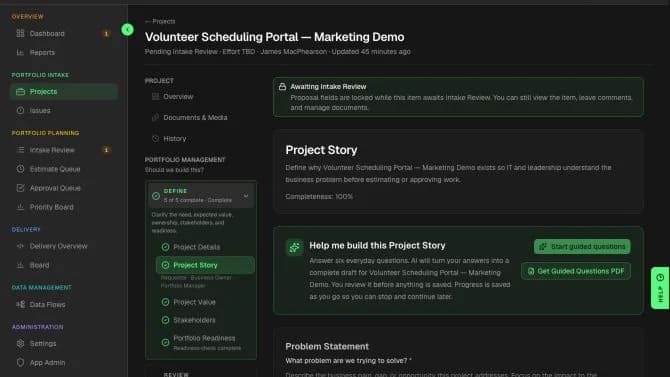
Precision Foundry replaces ceremony-first forms with guided, everyday questions. A non-technical stakeholder can submit a complete request. An engineer can understand it on the first read. No glossary required.
Common questions
Because the shared language became a private one. Stakeholders who cannot speak in epics and velocity stop correcting the record. Nodding looks like agreement. The request that reaches engineering is a ceremony object, not the broken process.
Yes, if that is how the team ships. Ceremony can stay inside the delivery team. The artifact a business user completes should not require it.
Who must change how they work, for how long, and what else stops while they do. Write those answers in plain text next to the technical estimate.
The stakeholder can read the page and recognize their week. An engineer can name the broken path on the first read. If either person needs a translator, the record is not done.
Precision Foundry keeps this guide attached to the request so the template does not live in a forgotten doc.
Request Private AlphaOptional cookies
We use optional technologies only with your choice. Strictly necessary cookies for sign-in and security always run. Cookie Policy