
Definition lives in email
The first story is a paragraph in a thread. It is treated as informal, so someone “writes it up.”
Real English
A software change can travel from a problem statement to a finished build without a new dialect at every handoff. Keep one living record: the original words, the people affected, reviewed answers, and a reachable owner. Testers and developers read the same sentences the requestor wrote.
For lean operators who want definition, questions, a decision, and delivery on one thread—without a project manager rewriting each step.
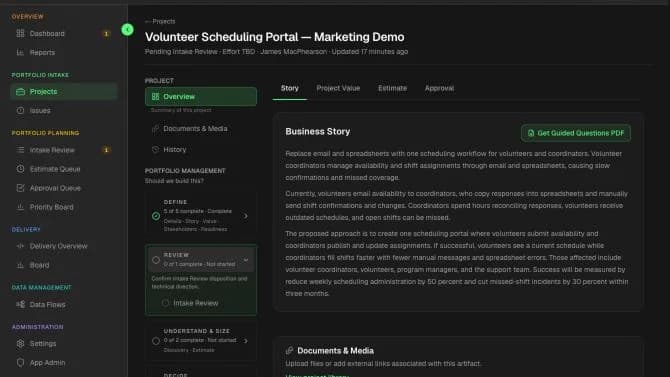
A real-English delivery thread keeps
Intake becomes a form. Discovery becomes a deck. Delivery becomes tickets. Testing becomes the ticket text. Nobody is lying. Each group is “clarifying.” The person who reported the broken process no longer recognizes the work.
The first story is a paragraph in a thread. It is treated as informal, so someone “writes it up.”
The write-up is pasted into a work item. The paste is now the spec. Context that did not fit the field is gone.
QA verifies what landed in the description. The original complaint is a memory.
Do not produce a cleaner artifact at each stage. Attach the next fact to the same record. If a sentence must change, date the change. The requestor should still be able to read the page at release.
Definition starts as a complete request. Capture it in software project intake so the first sentences are already on a record, not in email.
The next facts should attach, not migrate. Use requirements gathering software so questions stay on the same thread the requestor can still read.
If the story is still scattering across inboxes, return to software project intake and stop opening a new document to look official.
What happens today, who is affected, and what better looks like—in words the requestor already uses.
“Volunteers give up after three days of email scheduling” is definition. “Build a volunteer app” is a solution looking for a problem. Real English starts with the week they are living.
The next unknowns sit under the original story. Do not open a new brief to look official.
Official is how the dialect changes. A question like “Who approves a last-minute facility change?” can be answered by the same person who wrote the first paragraph.
Yes, no, or not yet, with the outcome that was approved and the outcome that was left out.
A hallway yes spends capacity. A written yes names the first-release result in the requestor’s language so delivery cannot quietly expand it.
Developers open the original record. If they need a board, the board item points back—it does not replace.
A frictionless handoff is not a blank ticket. It is clean, pre-validated scope with the source sentences still attached.
Verification starts from what the business user wrote, not from a cleaned-up description.
If QA can only see the ticket, they will test the ticket. The living record is the evidence that the finished build matches the original pain.
Practical template
Use this as a page audit. If a row lives in a different document, the dialect has already split.
Definition-to-delivery thread checklist
What stays in real English
Current process, people affected, desired result.
What must still be attached
The operations paragraph the requestor typed on day one.
What stays in real English
Missing decisions the requestor can answer.
What must still be attached
Who covers phones during training? Dated under the same story.
What stays in real English
Vendors, seasons, and policies that cannot move.
What must still be attached
“Not during fall registration” sits next to the problem, not in a RAID log.
What stays in real English
Yes, no, or not yet, plus what was left out.
What must still be attached
Yes to the two-day event option. Mobile app explicitly out.
What stays in real English
Work the delivery team executes.
What must still be attached
A board item that links back to the original paragraph.
What stays in real English
Evidence the finished change matches the original pain.
What must still be attached
QA opens the requestor’s sentences, not a rewritten ticket.
What stays in real English
The same owner who can still answer “did this fix your week?”
What must still be attached
Jordan confirms staff no longer spend three days on email scheduling.
| Stage | What stays in real English | What must still be attached |
|---|---|---|
| Definition | Current process, people affected, desired result. | The operations paragraph the requestor typed on day one. |
| Questions | Missing decisions the requestor can answer. | Who covers phones during training? Dated under the same story. |
| Constraints | Vendors, seasons, and policies that cannot move. | “Not during fall registration” sits next to the problem, not in a RAID log. |
| Decision | Yes, no, or not yet, plus what was left out. | Yes to the two-day event option. Mobile app explicitly out. |
| Build | Work the delivery team executes. | A board item that links back to the original paragraph. |
| Test | Evidence the finished change matches the original pain. | QA opens the requestor’s sentences, not a rewritten ticket. |
| Release | The same owner who can still answer “did this fix your week?” | Jordan confirms staff no longer spend three days on email scheduling. |
Worked example
A volunteer coordinator’s paragraph is still readable at release. Nobody “wrote it up.” Developers and testers used the same page.
What a continuous thread looks like in real English
What we recorded
We schedule volunteers in email and a shared spreadsheet
What we recorded
Who can approve a last-minute facility change?
What we recorded
Yes to a two-day option. The three-day option stays. No mobile app.
What we recorded
The build item points at that page. It does not replace it.
What we recorded
Testers read the coordinator’s sentences before they write a case
What we recorded
The coordinator still recognizes the work as their original week
| Check | What we recorded |
|---|---|
| Day-one sentence | We schedule volunteers in email and a shared spreadsheet |
| Attached question | Who can approve a last-minute facility change? |
| Decision sentence | Yes to a two-day option. The three-day option stays. No mobile app. |
| Delivery link | The build item points at that page. It does not replace it. |
| QA open | Testers read the coordinator’s sentences before they write a case |
| Release check | The coordinator still recognizes the work as their original week |
Real English is not casual. It is the discipline of not translating. If the requestor cannot read the page at release, a dialect split happened and the original problem is no longer the spec.
What a translated path produces vs. what a living record keeps
Living evidence record
One thread: problem, questions, decision, build, test
Living evidence record
The requestor’s sentences stay visible at every step
Living evidence record
QA opens the original complaint and the recorded yes
Living evidence record
Release success means the requestor’s week actually changed
| Translated artifacts | Living evidence record |
|---|---|
| Email → deck → ticket → test case, each in a new voice | One thread: problem, questions, decision, build, test |
| A PM “writes it up” so it looks official | The requestor’s sentences stay visible at every step |
| QA verifies the ticket description | QA opens the original complaint and the recorded yes |
| Release success means the ticket is closed | Release success means the requestor’s week actually changed |
A deck is a second source of truth. Put the decision on the request. Leaders can read a paragraph.
The paste becomes the spec. Archive is how the original voice is lost.
If the board is the only thing QA can open, they will test the board. Point them at the thread.
Ask the reachable owner whether their week changed. That sentence is the release check.
In Precision Foundry
Precision Foundry is a living evidence record. The original request becomes questions, a decision, and delivery without a new dialect at each handoff. That is a frictionless handoff: clean scope, same words, same owner.
Common questions
Write the current problem and the people affected. Attach questions and a recorded decision to that same page. Hand delivery a link to the thread, not a paraphrase. Let testers open the requestor’s sentences.
Yes. The board is a work surface. It should point at the living record. It should not become the only place the request exists.
Date the change on the same record and flag anyone already building from the old sentence. A silent rewrite is how the dialect splits again.
The reachable owner. If they cannot recognize the work as their original week, the thread was translated somewhere between definition and release.
Precision Foundry keeps this guide attached to the request so the template does not live in a forgotten doc.
Request Private AlphaOptional cookies
We use optional technologies only with your choice. Strictly necessary cookies for sign-in and security always run. Cookie Policy