
Generic questionnaires
Organize questions around the specific project context instead of asking every team to complete the same exhaustive checklist.
Requirements gathering software
Requirements gathering starts with the questions that would change the build. Precision Foundry keeps each answer attached to the original request, surfaces missing decisions, and turns reviewed evidence into testable requirements.
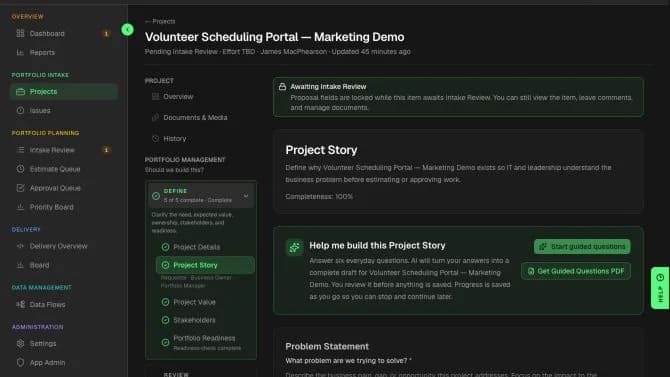
Guided discovery helps reduce
A long template is not the same as discovery. Teams need focused questions, visible uncertainty, and agreement on what the software must accomplish.
If you are comparing AI-assisted options rather than a blank template, start with the four groups of AI requirements tools, then come back here for the reviewable spec those tools still have to feed.
Organize questions around the specific project context instead of asking every team to complete the same exhaustive checklist.
Record open decisions and uncertain answers where reviewers can see, refine, and approve them.
Show which requirement areas are answered, which need attention, and who reviewed the current understanding.
Use interviews when one owner holds the rule, observation when the workaround is physical or repetitive, examples when words such as approved or complete hide disagreement, and document review when policy already constrains the answer. A technique earns its place by exposing a decision. A workshop with twelve observers and no owner is catering.
Ask who performs the work, what starts it, which exceptions consume time, who may approve the result, what information must survive, and what would make the first release fail. Then ask for one real example. The answer should change a requirement, close an unknown, or name an owner—not decorate a document.
A useful template records the source request, question, current answer, evidence, owner, review state, and unresolved decision. Do not turn unknown into blank. Blank looks forgotten; unknown tells the estimator where uncertainty still lives.
How to write acceptance criteria is not a brainstorm in sprint planning. Pull expected results from the reviewed answers on the original request: who is allowed to see the result, what complete means, and what is out of scope. Criteria typed from memory match the conversation in the room, not the change the business user asked for.
The process is not a workshop calendar. Carry the request forward, ask questions that could change scope, review the answers, and keep people responsible for approval.
Carry forward the business problem, desired outcome, stakeholders, and constraints instead of beginning discovery from a blank page.
Work through people and access, information, workflow rules, notifications, reporting, integrations, and operational needs.
Convert the agreed understanding into requirements that estimation, technical design, delivery, and testing can use.
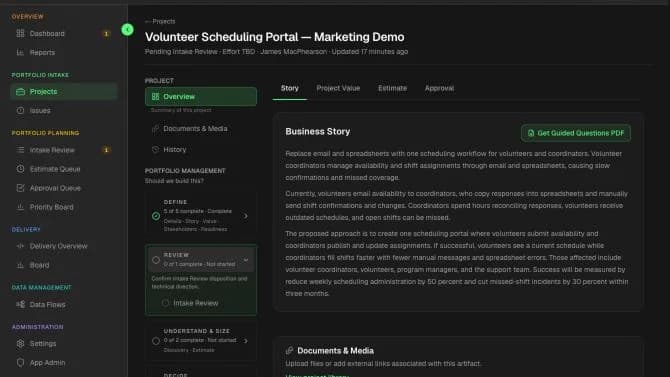
In the product
The same evidence supports value, effort, readiness, sequencing, approval, and a delivery plan—without recreating Project Intent.
Results
When requirements remain linked to their source decisions, teams can explain why an item exists and verify whether the delivered result solves the original problem.
Common questions
Requirements gathering software helps teams collect, organize, review, and maintain what a system must do and the constraints it must respect. It should make questions, assumptions, decisions, stakeholders, and approval status visible.
AI can suggest questions, identify gaps, and help draft clearer wording. It cannot replace stakeholder knowledge or accountability. Precision Foundry keeps AI-assisted content editable and requires people to review the result.
A requirement becomes more testable when it identifies the user or system behavior, relevant conditions, expected outcome, and important business rules. Those details can then support acceptance criteria and testing.
Precision Foundry carries the original problem, outcome, stakeholders, and constraints into discovery so requirement decisions remain traceable to the request that created them.
See how guided questions become reviewed, testable requirements—without a blank template.
Request Private AlphaOptional cookies
We use optional technologies only with your choice. Strictly necessary cookies for sign-in and security always run. Cookie Policy