
Prompt-to-PRD generators
Turn a paragraph or chat prompt into a spec document. Useful for a first draft you will edit offline. Weak when reviewers need a thread back to what the requestor actually said.
AI requirements gathering tools
These products fall into four groups: prompt-to-PRD generators, stakeholder interview tools, enterprise requirements platforms, and intake-to-delivery systems. Each group has a different job. Precision Foundry sits in the last one: the model suggests follow-ups from the original request, and people still accept, edit, or reject every draft.
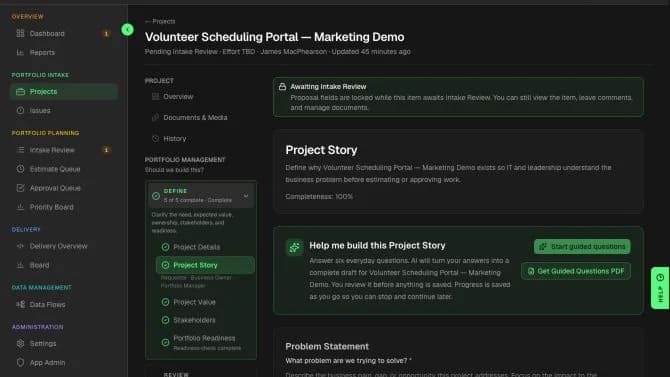
The reviewable group should
The labels sound similar; the jobs do not. Start the comparison by matching the work you need, then judge vendors inside that group. Precision Foundry is built for intake-to-delivery: reviewable AI output attached to the original request.
Turn a paragraph or chat prompt into a spec document. Useful for a first draft you will edit offline. Weak when reviewers need a thread back to what the requestor actually said.
Capture answers from conversations, workshops, or recorded interviews. Useful when elicitation is the bottleneck. Someone still has to turn those notes into a reviewable spec.
Store, baseline, and audit requirements across regulated programs. Useful when you need variants, traceability, and compliance evidence—not a first conversation with a department lead.
Keep the original request, questions, drafts, and later work on one thread. Useful when AI should suggest follow-ups people still accept, edit, or reject.
Match the group first. Then read the row that does that job. This table is not a ranking.
Named tools once the group is clear
Best for
Best for internal software intake connected to requirements and delivery.
Stakeholder input
The requestor writes the original software request in everyday language. Guided questions stay on that record.
Adaptive questions
The model suggests follow-ups from the original request. It does not start from a blank prompt or a stock checklist.
Human review
Reviewers accept, edit, or reject every draft before anyone treats the set as the spec.
Requirements traceability
Reviewed answers stay attached to the original request. Later stories can still point at those answers.
Delivery integration
Native boards, sprints, testing, and release stay on the same thread. Jira can remain optional coexistence.
Implementation complexity
Cloud SaaS. No enterprise ALM implementation program.
Best for
AI PRD software that turns stakeholder intake into a product requirements document.
Stakeholder input
Stakeholders submit through a guided intake form, then can continue by voice or text.
Adaptive questions
Official product copy says EpicPRD AI asks follow-up questions a seasoned business analyst would ask.
Human review
Product teams triage requests. Executives can be assigned to approve a locked PRD or request refinements.
Requirements traceability
Official pages do not describe requirements-to-test traceability.
Delivery integration
Official pages list sending a PRD to Jira, Linear, Cursor, and GitHub.
Implementation complexity
Cloud SaaS with a published free trial. Official pages do not describe an enterprise implementation program.
Best for
Asynchronous AI stakeholder interviews that return structured summaries.
Stakeholder input
Each stakeholder gets a one-on-one interview link after you brief the AI on the project.
Adaptive questions
The AI adapts questions to each person’s role and answers, and probes vague answers for specifics.
Human review
You can review structured summaries and full transcripts in Eliciteer. Official pages do not describe a formal accept-or-reject requirements gate.
Requirements traceability
Full transcripts are the interview audit trail. Official pages do not describe linking requirements to tests or delivery work.
Delivery integration
Structured results can be sent to Jira, Confluence, or docs via webhooks, n8n, Make, or Zapier.
Implementation complexity
Cloud SaaS. Brief the AI, share links, and run interviews in parallel. No workshop setup.
Best for
Guided questionnaires that produce a requirements specification, project scope, and wireframes.
Stakeholder input
Users answer pre-prepared questions. Official pages say multiple users can edit the same document.
Adaptive questions
Questions are pre-prepared. AI helps define project entities and offers recommendations by application type.
Human review
Users can update the project and regenerate the Word document. Official pages do not describe a formal accept-or-reject review gate.
Requirements traceability
Official FAQ says requirements can be linked to project outcomes, test cases, and deliverables.
Delivery integration
Official FAQ says the Task feature integrates with Atlassian Jira Boards. The product also generates tasks and a Word specification.
Implementation complexity
Browser SaaS for Chrome, Edge, and Safari, with onboarding after sign-up. The official site currently is not accepting new sign-ups.
Best for
Live requirements traceability and compliance for complex, often regulated, product development.
Stakeholder input
Teams author and review requirements in the platform. Official pages do not describe AI stakeholder interviews.
Adaptive questions
Official AI pages describe requirement quality analysis, test generation, and relationship discovery—not adaptive stakeholder questionnaires. Requirement generation is listed as in the works.
Human review
Built-in reviews and approvals, including Approval reviews that collect signatures and can transition items to an approved state.
Requirements traceability
Live end-to-end traceability across requirements, risks, designs, and tests, including forward and backward links.
Delivery integration
Official pages describe cross-tool traceability, including Jira integration for development work items.
Implementation complexity
Enterprise onboarding. Official pages say Jama migrates existing product information into compliant structures as part of onboarding. Sales start with a demo.
Best for
Requirements management natively inside Azure DevOps.
Stakeholder input
Author requirements in Smart Docs on Azure DevOps work items. Reviewers and approvers can be assigned from those documents.
Adaptive questions
Copilot4DevOps includes a Q&A assistant that elicits requirements through AI-driven structured questions. Official pages do not describe adapting those questions to each stakeholder’s live answers.
Human review
Review Management lets reviewers comment and approvers approve or reject, with a required comment on rejection and an audit trail.
Requirements traceability
Trace Analysis builds matrices between Azure DevOps work items, with coverage analytics from requirement to test step.
Delivery integration
Lives inside Azure DevOps Server and Services. Test Hub reporting links to Azure Test Plans.
Implementation complexity
Azure DevOps extension. Official pages say no separate URL, no separate login, and no data leaving the stack. A free trial is published.
| Tool | Best for | Stakeholder input | Adaptive questions | Human review | Requirements traceability | Delivery integration | Implementation complexity |
|---|---|---|---|---|---|---|---|
| Precision Foundry | Best for internal software intake connected to requirements and delivery. | The requestor writes the original software request in everyday language. Guided questions stay on that record. | The model suggests follow-ups from the original request. It does not start from a blank prompt or a stock checklist. | Reviewers accept, edit, or reject every draft before anyone treats the set as the spec. | Reviewed answers stay attached to the original request. Later stories can still point at those answers. | Native boards, sprints, testing, and release stay on the same thread. Jira can remain optional coexistence. | Cloud SaaS. No enterprise ALM implementation program. |
| EpicPRD (official product page) | AI PRD software that turns stakeholder intake into a product requirements document. | Stakeholders submit through a guided intake form, then can continue by voice or text. | Official product copy says EpicPRD AI asks follow-up questions a seasoned business analyst would ask. | Product teams triage requests. Executives can be assigned to approve a locked PRD or request refinements. | Official pages do not describe requirements-to-test traceability. | Official pages list sending a PRD to Jira, Linear, Cursor, and GitHub. | Cloud SaaS with a published free trial. Official pages do not describe an enterprise implementation program. |
| Eliciteer (official product page) | Asynchronous AI stakeholder interviews that return structured summaries. | Each stakeholder gets a one-on-one interview link after you brief the AI on the project. | The AI adapts questions to each person’s role and answers, and probes vague answers for specifics. | You can review structured summaries and full transcripts in Eliciteer. Official pages do not describe a formal accept-or-reject requirements gate. | Full transcripts are the interview audit trail. Official pages do not describe linking requirements to tests or delivery work. | Structured results can be sent to Jira, Confluence, or docs via webhooks, n8n, Make, or Zapier. | Cloud SaaS. Brief the AI, share links, and run interviews in parallel. No workshop setup. |
| Requiment (official product page) | Guided questionnaires that produce a requirements specification, project scope, and wireframes. | Users answer pre-prepared questions. Official pages say multiple users can edit the same document. | Questions are pre-prepared. AI helps define project entities and offers recommendations by application type. | Users can update the project and regenerate the Word document. Official pages do not describe a formal accept-or-reject review gate. | Official FAQ says requirements can be linked to project outcomes, test cases, and deliverables. | Official FAQ says the Task feature integrates with Atlassian Jira Boards. The product also generates tasks and a Word specification. | Browser SaaS for Chrome, Edge, and Safari, with onboarding after sign-up. The official site currently is not accepting new sign-ups. |
| Jama Connect (official product page) | Live requirements traceability and compliance for complex, often regulated, product development. | Teams author and review requirements in the platform. Official pages do not describe AI stakeholder interviews. | Official AI pages describe requirement quality analysis, test generation, and relationship discovery—not adaptive stakeholder questionnaires. Requirement generation is listed as in the works. | Built-in reviews and approvals, including Approval reviews that collect signatures and can transition items to an approved state. | Live end-to-end traceability across requirements, risks, designs, and tests, including forward and backward links. | Official pages describe cross-tool traceability, including Jira integration for development work items. | Enterprise onboarding. Official pages say Jama migrates existing product information into compliant structures as part of onboarding. Sales start with a demo. |
| Modern Requirements (official product page) | Requirements management natively inside Azure DevOps. | Author requirements in Smart Docs on Azure DevOps work items. Reviewers and approvers can be assigned from those documents. | Copilot4DevOps includes a Q&A assistant that elicits requirements through AI-driven structured questions. Official pages do not describe adapting those questions to each stakeholder’s live answers. | Review Management lets reviewers comment and approvers approve or reject, with a required comment on rejection and an audit trail. | Trace Analysis builds matrices between Azure DevOps work items, with coverage analytics from requirement to test step. | Lives inside Azure DevOps Server and Services. Test Hub reporting links to Azure Test Plans. | Azure DevOps extension. Official pages say no separate URL, no separate login, and no data leaving the stack. A free trial is published. |
Last reviewed: August 2026
We compared published capabilities on each vendor’s official product pages in August 2026. Columns describe the job those pages document. If a vendor does not publish a capability, the cell says so. This is not a ranking, a review score, or a price comparison.
Match the work you have, not a product name. Each path below belongs to one group in the comparison.
The idea is already understood. The main need is document drafting—a first spec you will edit, not a missing conversation with stakeholders.
The main need is collecting missing information from clients or internal stakeholders. Those answers still have to become a reviewed spec.
The organization needs formal baselines, variants, compliance evidence, or regulated traceability. That is a different job than software intake.
Internal software requests need to remain connected to discovery, estimates, approval, requirements, delivery, and testing. The original request stays the thread.
Once answers are accepted, Precision Foundry can draft stories from those requirements. People still edit or reject every story. Generating a backlog from an unreviewed prompt is a different, weaker job.
If the job is intake-to-delivery, treat the model as an assistant on an existing request. Precision Foundry can suggest questions and draft wording. A person still marks what is true, uncertain, or out of scope.
The tool reads the problem, people, owner, and constraints the requestor already wrote. It does not start from a blank chat.
Follow-ups fill gaps meetings skip—what must stay the same, what would make the change fail, and who else is affected.
Drafts stay editable. A reviewer accepts, rewrites, or rejects each one before anyone treats the set as the spec.
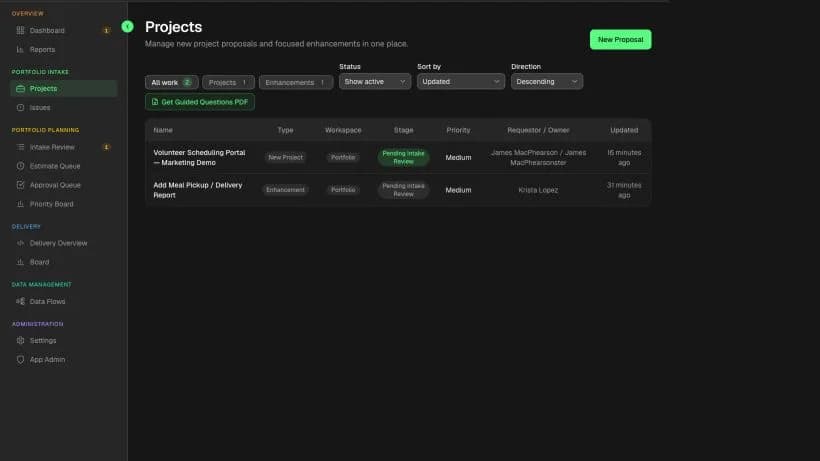
In the product
The product page is the assist on one request. This page is the buying comparison: which group stays reviewable, and which writes a disposable PRD.
Results
Teams get faster coverage of the questions that matter, without handing the spec to a model. The original request remains the source. Drafts are candidates.
Common questions
There is no single best tool. Match the group first: a PRD generator, a stakeholder interview tool, an enterprise platform, or an intake-to-delivery system. Precision Foundry belongs in the last group, where people still accept or reject every draft.
Some tools can. Stakeholder interview products send each person a conversation link and return summaries. Precision Foundry does not run those interviews. It suggests follow-ups from the original written request.
Gathering stays attached to what stakeholders said and leaves review with people. PRD generation turns a prompt into a document you edit offline. A generated PRD is a first draft, not a gathered spec.
Not without review. A model can invent constraints or sound certain about a guess. Treat drafts as candidates. A person still marks what is true, uncertain, or out of scope.
Several tools in the comparison publish a Jira path: sending a PRD, posting interview results through webhooks, or creating Jira tasks. Precision Foundry keeps delivery on the same thread and treats Jira as optional coexistence.
No. They can draft questions and wording. Someone still has to judge what is true, negotiate tradeoffs, and own the spec. That is analyst work, whether or not the title exists.
Some can draft stories from a prompt. Precision Foundry generates user stories from requirements that people already reviewed on the original request. Unreviewed AI stories are a new backlog, not a traceable slice.
See suggested follow-ups and draft requirements on one real request—then edit them like any other answer.
Request Private AlphaOptional cookies
We use optional technologies only with your choice. Strictly necessary cookies for sign-in and security always run. Cookie Policy