
The form assumes PM vocabulary
Words like charter, deliverable, and workstream stop the person who actually understands the broken process.
Software project intake template
A software project intake template collects the business problem, the people affected, and the outcome that would make the change worth doing. It does not ask a department manager to write a charter, a WBS, or a solution design. Use it as a prompt set—not as a substitute for the product that stores the request. The same fields work as a software feature request intake template.
For department managers and the person closest to the problem—especially when nobody on staff is a full-time project manager.
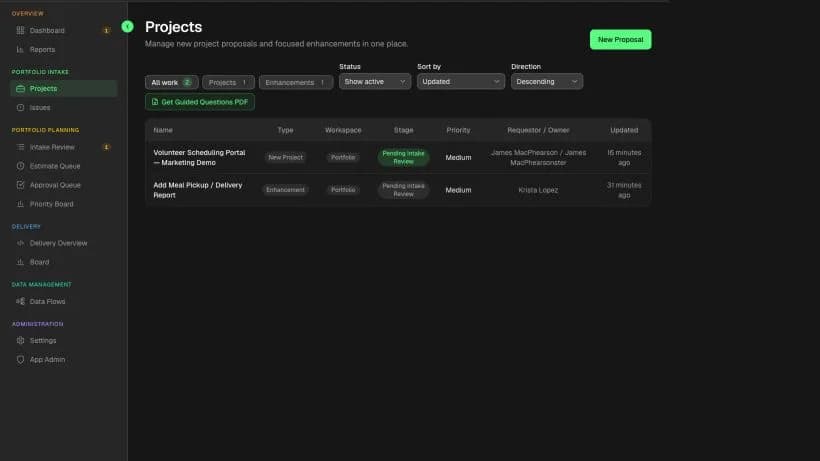
A software project intake template asks for
A form that asks for scope, milestones, RAID logs, or a preferred architecture will sit unused—or get filled with a requested solution and a deadline. The organization then reconstructs the real problem in meetings. Teams without a PMO need a shorter template that a department manager can complete from what they already know.
Words like charter, deliverable, and workstream stop the person who actually understands the broken process.
“What system do you want?” hides the problem. Reviewers cannot compare requests that start at different levels of invention.
When people skip fields they do not understand, IT treats the request as low quality instead of poorly designed intake.
The job of a software project intake template is not to plan the project. It is to make the request reviewable. Everything else—discovery questions, estimates, priority, and delivery planning—comes after someone can understand the problem without a meeting.
This page is the copy-ready prompt set. When the story needs to travel into review without a shared doc, use software project intake so the same record reaches the next step.
A complete template is not a plan. After the story is understandable, requirements gathering software turns it into reviewed answers instead of a kickoff that invents tasks.
If reviewers cannot see what is missing, a spreadsheet will stall. Run the prompts in software project intake so completeness is visible without a project manager rewriting the request.
Ask what happens today, including handoffs and tools, in the requestor’s own words.
A good answer names the process, not the hoped-for product. “We schedule volunteers in email and a shared spreadsheet” is intake. “We need an app” is a solution looking for a problem.
Who is affected, what extra work or risk this causes, and what happens if nothing changes.
Include employees, customers, volunteers, partners, or reviewers. Pain can be time, errors, cost, compliance exposure, or people giving up. If the requestor cannot name who hurts, the request is not ready.
Ask what should be different when the change works. Allow “I am not sure how” as a valid answer.
The desired future is an outcome: fewer days to run an event, fewer duplicate records, a supervisor who can see open requests. Implementation choices wait until requirements and estimates exist.
Someone must be reachable, and any hard dates or limits should be visible.
Owner means a business person who can answer follow-up questions—not a project manager. Timing is a window or a reason, not a fake go-live. Constraints include policy, vendors, systems that cannot change, or busy seasons.
A reviewer checks whether the story can be understood, not whether it sounds like a PMO document.
Ready enough means: problem, people, outcome, owner, and known limits are present. Missing solution design is expected. Missing who is affected is not.
Practical template
Copy these prompts into a form, a shared doc, or the first screen in a workflow. Leave any answer as “unknown” rather than inventing one. The examples are fictional.
Copy-ready software project intake template
Why it is here
Gives reviewers the current process without requiring a process map.
What a complete answer looks like
Tournament staff plan events over three days and reserve facilities by email and a spreadsheet.
Why it is here
Shows the real audience before anyone sizes a solution.
What a complete answer looks like
Tournament staff, volunteers, students, parents, and facility coordinators.
Why it is here
Separates inconvenience from cost, risk, or lost capacity.
What a complete answer looks like
Facilities are hard to reserve, volunteers give up three days, and event costs stay high.
Why it is here
Defines the outcome without locking a vendor or architecture.
What a complete answer looks like
Staff can run the same event in two days with less facility and volunteer time.
Why it is here
Captures a hunch without requiring a design. “Not sure yet” is acceptable.
What a complete answer looks like
Add a two-day tournament option while keeping the three-day option. Or: I am not sure yet.
Why it is here
Gives later estimates and approval something to test against.
What a complete answer looks like
Average event setup drops from three days to two, with fewer last-minute facility changes.
Why it is here
Someone must answer follow-up questions. This is not a project-manager field.
What a complete answer looks like
Jordan Lee, operations manager, can speak for the department.
Why it is here
Surfaces busy seasons, policies, vendors, and systems that cannot move.
What a complete answer looks like
Cannot launch during fall registration. Existing payment vendor must stay in place.
| Prompt | Why it is here | What a complete answer looks like |
|---|---|---|
| What is happening today? | Gives reviewers the current process without requiring a process map. | Tournament staff plan events over three days and reserve facilities by email and a spreadsheet. |
| Who is affected? | Shows the real audience before anyone sizes a solution. | Tournament staff, volunteers, students, parents, and facility coordinators. |
| What problems does this cause? | Separates inconvenience from cost, risk, or lost capacity. | Facilities are hard to reserve, volunteers give up three days, and event costs stay high. |
| What should be different when this works? | Defines the outcome without locking a vendor or architecture. | Staff can run the same event in two days with less facility and volunteer time. |
| What change do you think is needed? | Captures a hunch without requiring a design. “Not sure yet” is acceptable. | Add a two-day tournament option while keeping the three-day option. Or: I am not sure yet. |
| How will you know it worked? | Gives later estimates and approval something to test against. | Average event setup drops from three days to two, with fewer last-minute facility changes. |
| Who owns this request? | Someone must answer follow-up questions. This is not a project-manager field. | Jordan Lee, operations manager, can speak for the department. |
| What timing or constraints matter? | Surfaces busy seasons, policies, vendors, and systems that cannot move. | Cannot launch during fall registration. Existing payment vendor must stay in place. |
Worked example
A volunteer coordinator can complete this template in one sitting. A reviewer can decide whether the request is ready for discovery without translating it into PM artifacts.
What “done enough” looks like without a project manager
What we recorded
Volunteer coordinator who runs seasonal events
What we recorded
Today’s process, who struggles, and the outcome they need
What we recorded
Epics, milestones, RAID logs, or a recommended stack
What we recorded
Problem, people, outcome, owner, and constraints are present
What we recorded
Guided discovery questions—not a kickoff that invents tasks
What we recorded
Return the two missing answers instead of scheduling another meeting
| Check | What we recorded |
|---|---|
| Idea contact | Volunteer coordinator who runs seasonal events |
| What they know | Today’s process, who struggles, and the outcome they need |
| What they do not write | Epics, milestones, RAID logs, or a recommended stack |
| Reviewer check | Problem, people, outcome, owner, and constraints are present |
| Next step if complete | Guided discovery questions—not a kickoff that invents tasks |
| Next step if incomplete | Return the two missing answers instead of scheduling another meeting |
The template succeeds when a reviewer can understand the request without the requestor in the room. That is the substitute for a project manager at intake—not a thinner charter.
What a PM form asks vs. what a non-PM template collects
Non-PM intake template
What is happening today, in everyday language
Non-PM intake template
Who is affected and what should be different
Non-PM intake template
A reachable owner, timing, and known constraints
Non-PM intake template
A reviewable story—then stop. Planning comes after.
| PM-style form | Non-PM intake template |
|---|---|
| Charter, milestones, WBS, and a RAID log | What is happening today, in everyday language |
| Preferred vendor, architecture, or workstreams | Who is affected and what should be different |
| A project plan the requestor cannot honestly write | A reachable owner, timing, and known constraints |
| A “complete” PMO packet before anyone understands the problem | A reviewable story—then stop. Planning comes after. |
Dates, phases, and resource plans belong after discovery and estimates. Asking for them at intake produces fiction.
Capture constraints (“must keep the payment vendor”). Do not force a solution name when the problem is still being understood.
Unknown is a valid answer. Forcing a guess creates false confidence and trains people to invent scope.
Broken-now issues and small fixes need a different path. A project intake template is for work that still needs a decision.
In Precision Foundry
Precision Foundry is built for the person who knows the job, not the person who knows project-management language. The prompts on this page are the template. The product stores the same story so reviewers see whether the request is complete enough to continue.
Common questions
Ask for the current situation, who is affected, the problems it causes, the desired outcome, any solution idea (including “not sure”), how success will be recognized, a business owner, and known timing or constraints. Do not ask a department manager for a charter, work breakdown, or technical design. The same fields work as a software feature request intake template.
The same fields. A software project intake template for teams without project managers is a prompt set the person closest to the work can complete. It is not a thinner charter, and it is not a ticket dump.
The person closest to the business problem. They do not need project-management training. A reviewer or IT partner can add context later. The owner field exists so follow-up questions have a name.
Check whether a stranger to the request can understand the problem, the people, the outcome, the owner, and the hard limits. If those are present, the request can move to discovery. If they are not, send back the missing answers instead of holding a kickoff.
A shared document can hold the prompts. Software helps when requests scatter across email, when reviewers cannot see what is missing, and when the story needs to travel into discovery, estimates, and approval without being rewritten.
Precision Foundry keeps this guide attached to the request so the template does not live in a forgotten doc.
Request Private AlphaOptional cookies
We use optional technologies only with your choice. Strictly necessary cookies for sign-in and security always run. Cookie Policy