
The code estimate was the whole plan
A code-only number and a vendor quote size software work. They do not size who must learn the new process or what else stops while they do.
For engineering directors
You don’t need an active PMO or parallel questionnaires to protect delivery dates. After early IT triage chooses the discovery path, one BA facilitates the shared answers and Business and IT size their parts of the work on the same record before investment approval.
For engineering directors, VPs of engineering, and founders who refuse to hire a PMO just to protect a delivery date.
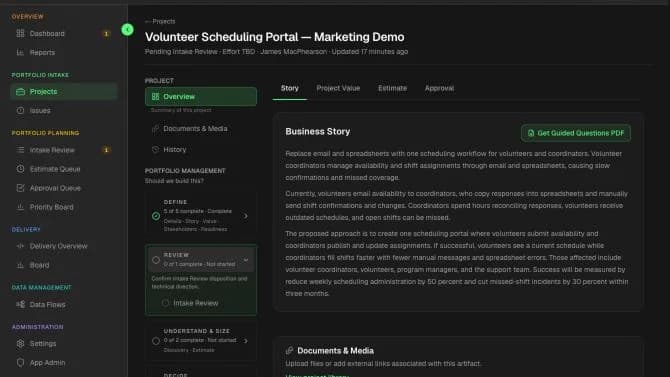
Symmetric Sizing makes visible
You do not need a certification to protect a date. Engineering often sizes the build honestly. The project still slips because legal review, support scripts, customer notices, and first-month backfill were never on the same record.
A code-only number and a vendor quote size software work. They do not size who must learn the new process or what else stops while they do.
Training, staff notices, and go-live ownership get a “we’ll handle that in ops” until the week before launch, when they become the reason the date slips.
When only one number was funded, the late training plan reads as a slipped build. Both sides needed a number before anyone said yes.
The traditional PMO way
“Two weeks for the screens and the hookup.”
Symmetric Sizing
Two weeks plus the hours to teach, cover shifts, and notify people.
The traditional PMO way
Launch readiness lives in a separate deck.
Symmetric Sizing
Training, process change, and go-live sit on the request.
The traditional PMO way
A hallway yes only funds the build.
Symmetric Sizing
Leaders see both numbers before they record yes, no, or not yet.
The traditional PMO way
Symmetric Sizing
“Two weeks for the screens and the hookup.”
Two weeks plus the hours to teach, cover shifts, and notify people.
Launch readiness lives in a separate deck.
Training, process change, and go-live sit on the request.
A hallway yes only funds the build.
Leaders see both numbers before they record yes, no, or not yet.
Ready for Discovery is not the funding decision. Once the IT Owner has recommended Standard Discovery, Lightweight Discovery, or Existing Solution Review, one BA facilitates the shared questions. Then Business and IT estimate their own effort before anyone records the investment yes.
Use the path and specialist reviews identified during IT Triage. The BA’s shared answers become the source for both estimates.
Business counts training, process change, and adoption. IT counts the build, integrations, data movement, and cutover. Both remain on the same request.
Record yes, no, or not yet on the pair. Approved work keeps those numbers attached so a later slip has an owner.
Common questions
No. Delivery teams can still count sprint work after the investment is approved. These estimates follow IT-triaged, BA-facilitated discovery and size the overall Business and IT change before the funding decision.
Training design, learner time, supervisor time, backfill, first-month support, customer or staff notifications, and process changes that must be true for the software to be used. If it is required for the launch to stick, it is part of the size.
That refusal is the signal. A missing number is more honest than a launch date that assumed training was free. Foundry keeps the gap visible instead of letting the technical estimate stand in for the whole change.
No. One BA facilitates the selected discovery path and records answers from the appropriate Business or IT perspective. The early IT-triage signoff supplies the technical routing context; the product does not require several people to run the questionnaire simultaneously.
Software change estimation here is the pair before coding starts: business rollout next to the technical build. Story points can still size sprint work after the investment is approved. This page is the gate that makes both sides of the change visible first.
No. An IT project cost estimate for software change includes training, coverage, and adoption next to the technical build. That pair is software cost estimation before a yes. A development quote alone is half the cost.
Request Private Alpha and see a paired estimate before the next launch date is set from a code-only number.
See Both Sides of the BuildOptional cookies
We use optional technologies only with your choice. Strictly necessary cookies for sign-in and security always run. Cookie Policy
For engineering directors
You don’t need an active PMO or parallel questionnaires to protect delivery dates. After early IT triage chooses the discovery path, one BA facilitates the shared answers and Business and IT size their parts of the work on the same record before investment approval.
For engineering directors, VPs of engineering, and founders who refuse to hire a PMO just to protect a delivery date.
Symmetric Sizing makes visible
You do not need a certification to protect a date. Engineering often sizes the build honestly. The project still slips because legal review, support scripts, customer notices, and first-month backfill were never on the same record.
A code-only number and a vendor quote size software work. They do not size who must learn the new process or what else stops while they do.
Training, staff notices, and go-live ownership get a “we’ll handle that in ops” until the week before launch, when they become the reason the date slips.
When only one number was funded, the late training plan reads as a slipped build. Both sides needed a number before anyone said yes.
The traditional PMO way
“Two weeks for the screens and the hookup.”
Symmetric Sizing
Two weeks plus the hours to teach, cover shifts, and notify people.
The traditional PMO way
Launch readiness lives in a separate deck.
Symmetric Sizing
Training, process change, and go-live sit on the request.
The traditional PMO way
A hallway yes only funds the build.
Symmetric Sizing
Leaders see both numbers before they record yes, no, or not yet.
The traditional PMO way
Symmetric Sizing
“Two weeks for the screens and the hookup.”
Two weeks plus the hours to teach, cover shifts, and notify people.
Launch readiness lives in a separate deck.
Training, process change, and go-live sit on the request.
A hallway yes only funds the build.
Leaders see both numbers before they record yes, no, or not yet.
Ready for Discovery is not the funding decision. Once the IT Owner has recommended Standard Discovery, Lightweight Discovery, or Existing Solution Review, one BA facilitates the shared questions. Then Business and IT estimate their own effort before anyone records the investment yes.
Use the path and specialist reviews identified during IT Triage. The BA’s shared answers become the source for both estimates.
Business counts training, process change, and adoption. IT counts the build, integrations, data movement, and cutover. Both remain on the same request.
Record yes, no, or not yet on the pair. Approved work keeps those numbers attached so a later slip has an owner.
Common questions
No. Delivery teams can still count sprint work after the investment is approved. These estimates follow IT-triaged, BA-facilitated discovery and size the overall Business and IT change before the funding decision.
Training design, learner time, supervisor time, backfill, first-month support, customer or staff notifications, and process changes that must be true for the software to be used. If it is required for the launch to stick, it is part of the size.
That refusal is the signal. A missing number is more honest than a launch date that assumed training was free. Foundry keeps the gap visible instead of letting the technical estimate stand in for the whole change.
No. One BA facilitates the selected discovery path and records answers from the appropriate Business or IT perspective. The early IT-triage signoff supplies the technical routing context; the product does not require several people to run the questionnaire simultaneously.
Software change estimation here is the pair before coding starts: business rollout next to the technical build. Story points can still size sprint work after the investment is approved. This page is the gate that makes both sides of the change visible first.
No. An IT project cost estimate for software change includes training, coverage, and adoption next to the technical build. That pair is software cost estimation before a yes. A development quote alone is half the cost.
Request Private Alpha and see a paired estimate before the next launch date is set from a code-only number.
See Both Sides of the Build