
Only the IT estimate is visible
Story points and vendor quotes size the build. They do not size who must learn the new work or what else stops while they do.
Software business case software
Software business case software turns the selected discovery path into paired evidence. After a BA facilitates the shared answers, Precision Foundry records business effort next to technical effort on the original request so the later investment decision is based on the whole change—not a slide deck.
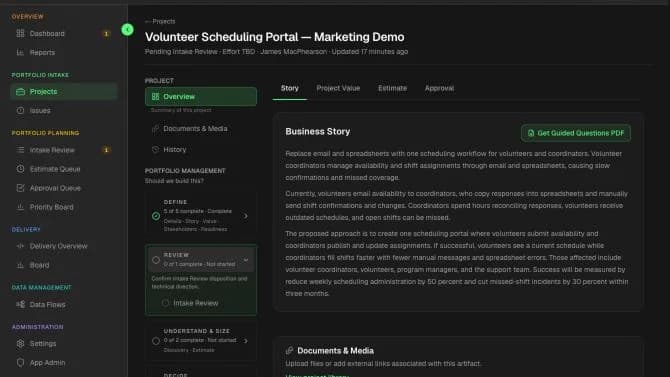
A usable software business case includes
A technical estimate can be honest and still leave leaders with a false total. If training, backfill, and first-month support are missing, the case is a development quote. Software business case software should force both sides onto one record before anyone spends capacity.
See how IT chooses the discovery path during IT project intake before the case is estimated.
Need the written pair first? Start with the software business case template, then bring both numbers to approval.
Ready to record the decision? The IT project approval process writes yes, no, or not yet on that same case.
Story points and vendor quotes size the build. They do not size who must learn the new work or what else stops while they do.
A slide can be updated without the requestor seeing it. The original problem and the numbers drift apart before approval.
Without a recorded decision on both estimates, capacity disappears into work nobody agreed to fund as a pair.
A software business case template is the written pair: training and adoption next to the build. Use it after the request is understandable. It is not a charter and it is not a slide deck that testers cannot open later.
An IT project approval process records yes, no, or not yet on that paired case. If either estimate is missing, the process writes not-yet. A hallway nod is not approval.
The IT Owner first recommends Standard Discovery, Lightweight Discovery, Existing Solution Review, or Not an IT Project and flags Security, Vendor, Data, or Architecture participation. That routing keeps a small request from carrying a heavyweight case and prevents teams from estimating new development before checking an existing solution.
The business case starts after Intake Review, IT Triage, and the selected discovery path. It is the paired estimate and the later investment decision—not the earlier Ready for Discovery decision, a charter, or a sprint plan.
One BA records the Business and IT perspectives on the shared request. The case starts from those reviewed answers instead of asking separate respondents to run competing questionnaires.
Business sizes training, process change, and adoption while IT sizes the build, integrations, data movement, and cutover from the same request.
Leaders see both estimates on one record and say yes, no, or not yet. Approved work keeps those numbers attached.
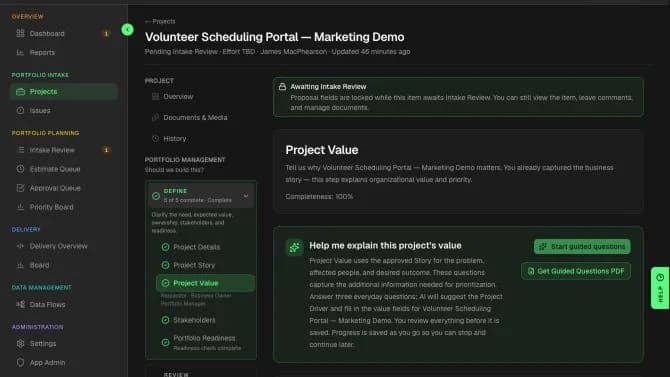
In the product
The software business case is not a file beside the work. Precision Foundry keeps the paired numbers on the request that later becomes requirements and delivery.
Results
Leaders decide with a paired picture: people-and-process effort next to build effort. The case stays on the request instead of becoming a forgotten deck.
Common questions
It is software that turns a software request into an investment record: a business estimate, a technical estimate, and a recorded decision. Precision Foundry does that on the original request. It is not a generic business-case template and it is not a project-management charter.
A business estimate sizes training, process change, communication, and adoption. An IT estimate sizes the build. Dual-sided estimation puts both numbers on one record so leaders do not approve a development quote and discover the people cost later.
After Intake Review, IT Triage, and the selected discovery path—but before capacity is committed. Writing the case from a slogan invents numbers. Treating Ready for Discovery as investment approval skips the evidence the case is meant to provide.
No. The business case produces the paired evidence. Prioritization compares decision-ready software investments against budget and capacity. One request can have a strong case and still wait.
Yes. Use a software business case template that records both estimates on the original request. It is not a generic charter and it is not a slide deck testers cannot open later.
The IT project approval process records yes, no, or not yet on that paired case. If either estimate is missing, write not-yet. A hallway nod is not the process.
Yes. Software change estimation in Precision Foundry is the paired record: the department sizes training, process change, and adoption; IT sizes the build, integrations, and cutover. Leaders see both numbers before they record a yes. A code-only quote is not a complete software change estimate.
Put training, process change, and the technical build on one record—then decide with both numbers visible.
Request Private AlphaOptional cookies
We use optional technologies only with your choice. Strictly necessary cookies for sign-in and security always run. Cookie Policy