
Scores without a budget
A high score that ignores remaining funds is not a decision. Show what the investment costs the portfolio this quarter.
Project prioritization software
Project prioritization software makes budget and capacity tradeoffs visible after each request has completed its routed discovery and Business and IT estimates. Precision Foundry keeps that investment decision separate from the earlier Ready for Discovery decision.
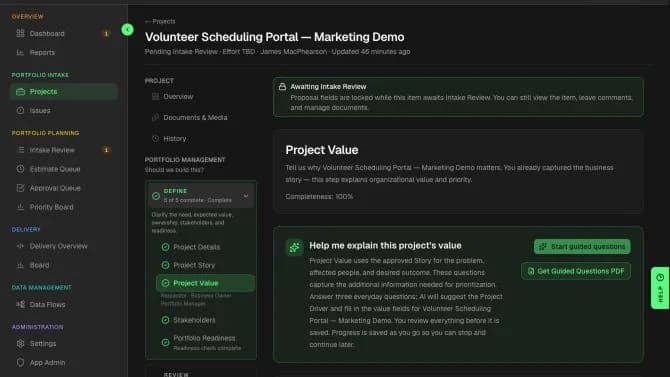
A portfolio tradeoff makes visible
Portfolio decisions become political when every request is scored in isolation. Project prioritization software should show the budget and capacity each investment consumes—and which other work is displaced.
See how requests reach this point through IT demand management software with early IT triage.
Review the paired evidence in software business case software before comparing investments.
A high score that ignores remaining funds is not a decision. Show what the investment costs the portfolio this quarter.
Connect desirability to the people and calendar the work will consume so leaders can see what else will stall.
Record what is deferred or declined when a request is funded. A portfolio that only says yes is already overcommitted.
Ready for Discovery confirms that Intake Review and IT Triage produced an appropriate route. It authorizes Standard Discovery, Lightweight Discovery, or Existing Solution Review; it does not commit budget. Portfolio approval happens after the shared questions and both estimates make the tradeoff visible.
Precision Foundry compares requests only after Intake Review, the selected discovery path, and Business and IT estimates. Ready for Discovery authorizes investigation; this step decides whether the resulting investment receives budget and capacity.
Bring the BA-facilitated answers and both estimates forward from the selected discovery path so leaders compare understood investments, not intake slogans.
Line the candidate up against other funded work. If capacity is already spoken for, the tradeoff is the decision.
Keep the yes, not yet, or no—and the budget reason—attached to the investment that moved, waited, or stopped.
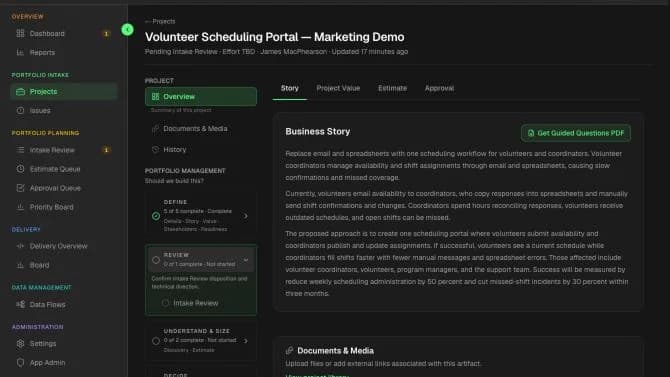
In the product
Approved investments keep the budget and capacity evidence that beat the alternatives. That record is the tradeoff—not a slogan.
Results
Leaders can show why this investment used the remaining capacity and why another request waits. Requestors see the constraint, not a mysterious rank.
Common questions
Project prioritization software helps an organization compare proposed software investments using budget, capacity, strategic fit, and what else will be displaced. It should preserve the tradeoff behind a ranking instead of producing an unexplained score.
Put comparable cost and capacity on one list. Weigh those figures against strategy, then record what the yes displaces. Do not rank solely by deadline or sponsor volume, and do not confuse a submission form with a funding decision.
No. Precision Foundry can summarize context and surface missing cost information, but people remain responsible for budget, capacity, and the funding call. AI is not an automatic approval gate.
Prioritization decides which investments get budget and capacity this quarter. Planning orders the work that already earned that yes. Mixing those jobs is how two pages start competing for the same search phrase.
See the portfolio tradeoff before the loudest sponsor fills next quarter’s capacity.
Request Private AlphaOptional cookies
We use optional technologies only with your choice. Strictly necessary cookies for sign-in and security always run. Cookie Policy