
The ask arrived as a product name
“We need a portal” has no edge. Adjacent reports, roles, and integrations sound like the same project the moment someone starts estimating.
Clear project scope
A technical lead cannot estimate a product name. Get a clear project scope from business stakeholders by writing the current path, who is stuck, the first-release outcome, and the exclusions—before anyone opens a sizing conversation.
For technical leads and engineering managers who keep estimating feature names because the real scope still lives in a stakeholder’s head.
Project scope is clear enough to estimate when
Business stakeholders rarely hide the scope on purpose. They arrive with a product name, a date, and a feeling that “everyone already knows.” A technical lead who estimates that slogan is guessing. Getting a clear project scope from business stakeholders is elicitation: write the facts you will not size without, then stop. It is not a kickoff, and it is not sprint planning.
“We need a portal” has no edge. Adjacent reports, roles, and integrations sound like the same project the moment someone starts estimating.
Stakeholders nod through a walkthrough, then reopen the outcome in Slack. If exclusions were never written, every later idea is still in scope.
A range against an unnamed first release trains the organization to treat a guess as a commitment. The date slips; the missing facts were never recorded.
How to get a clear project scope from business stakeholders is a refusal rule, not a workshop format. A technical lead can run it in one sitting. Do not translate their words into epics until they recognize the problem, the people, the first-release outcome, and the exclusions on one page.
A complete request from software project intake is what makes the current path, the people, and the first-release outcome reviewable before anyone estimates.
Turn the unanswered rows into reviewed answers in requirements gathering software instead of inventing them in a workshop or a Slack thread.
If a stakeholder still cannot name an exclusion, send them back through software project intake —do not open an estimate against a product name.
Get the current path in their words—handoffs, tools, and where it fails—before anyone names a system.
“Staff reserve facilities by email and a spreadsheet, and volunteers give up by day three” is scope input. “We need an app” is a solution looking for a problem. Write the path first.
A clear project scope names the people who feel the pain, not a persona workshop.
Include the department doing the work, the people who wait on them, and the workaround they already run. If the stakeholder cannot name who hurts, you do not have a scope yet.
Ask what should be different when the first change works. Allow “I am not sure how.”
“Staff can run the same event in two days” can be estimated later. “A modern scheduling platform” cannot. The outcome is the scope. The build is not.
Exclusions are how a technical lead knows the estimate has an edge.
“No historical import, no public status page, no mobile app in the first release” is a decision. If they will not name an exclusion, they are still buying a slogan.
Someone from the business must answer follow-up questions. A steering committee is not an owner.
Owner means a named person who can confirm the current path and the exclusions. If that person is “the department,” the scope will reopen the first time a developer asks a concrete question.
A missing fact is not a story-point problem. Send the unanswered row back instead of inventing it in a workshop.
If the first-release outcome or an exclusion is blank, do not estimate. How to get a clear project scope from business stakeholders ends here: write the five facts, or do not start the number.
Practical template
Use these as a live prompt set with a stakeholder, not as a slide. If a row is blank, the project scope is not clear. The examples use a fictional volunteer scheduling request.
Five questions you will not estimate without
Why you ask it
Gives the current path without a process map or a requested architecture.
A clear answer
Tournament staff plan events over three days and reserve facilities by email and a spreadsheet.
Why you ask it
Shows the real audience before anyone sizes a portal or a vendor.
A clear answer
Staff, volunteers, and facility coordinators. Volunteers give up by day three; staff re-key the same grid.
Why you ask it
Defines an outcome a later estimate can test against.
A clear answer
Staff can run the same event in two days with fewer last-minute facility changes.
Why you ask it
An estimate without an exclusion is a guess with a date attached.
A clear answer
No historical import, no public status page, no mobile app.
Why you ask it
A committee cannot confirm a constraint when a developer is blocked.
A clear answer
Jordan Lee, operations manager, speaks for the department.
Why you ask it
Busy seasons, vendors, and policy limits change the estimate if they appear later.
A clear answer
Cannot launch during fall registration. Existing payment vendor stays in place.
| Question | Why you ask it | A clear answer |
|---|---|---|
| What happens today? | Gives the current path without a process map or a requested architecture. | Tournament staff plan events over three days and reserve facilities by email and a spreadsheet. |
| Who is stuck, and what do they do instead? | Shows the real audience before anyone sizes a portal or a vendor. | Staff, volunteers, and facility coordinators. Volunteers give up by day three; staff re-key the same grid. |
| What should be different after the first release? | Defines an outcome a later estimate can test against. | Staff can run the same event in two days with fewer last-minute facility changes. |
| What is deliberately out of scope for the first release? | An estimate without an exclusion is a guess with a date attached. | No historical import, no public status page, no mobile app. |
| Who can answer follow-up questions? | A committee cannot confirm a constraint when a developer is blocked. | Jordan Lee, operations manager, speaks for the department. |
| What timing or constraints cannot move? | Busy seasons, vendors, and policy limits change the estimate if they appear later. | Cannot launch during fall registration. Existing payment vendor stays in place. |
Worked example
An engineering lead sits with an operations manager for a fictional volunteer scheduling change. The manager arrived with “we need an app.” Forty minutes later the lead has a scope that can be estimated—or sent back.
What a technical lead can take back from one stakeholder conversation
What we recorded
“A scheduling app before fall registration”
What we recorded
Email and a shared spreadsheet across a three-day event setup
What we recorded
Staff, volunteers, and facility coordinators
What we recorded
Staff run the same event in two days
What we recorded
No historical import, no public status page, no mobile app
What we recorded
Operations manager who can confirm the path and the exclusions
What we recorded
Estimate against that boundary—or return the blank exclusion
What we recorded
Open a workshop to invent the missing facts, then size the slogan
| Check | What we recorded |
|---|---|
| What they asked for | “A scheduling app before fall registration” |
| Current path | Email and a shared spreadsheet across a three-day event setup |
| Who is stuck | Staff, volunteers, and facility coordinators |
| First-release outcome | Staff run the same event in two days |
| Exclusions | No historical import, no public status page, no mobile app |
| Owner | Operations manager who can confirm the path and the exclusions |
| Correct next step | Estimate against that boundary—or return the blank exclusion |
| Incorrect next step | Open a workshop to invent the missing facts, then size the slogan |
The conversation succeeded when the operations manager recognized their own work on the page. That is a clear project scope. Translating it into epics before those five facts exist is how estimates miss.
What the stakeholder said vs. what a technical lead can estimate
What a technical lead can estimate
Staff plan events over three days in email and a spreadsheet
What a technical lead can estimate
Volunteers give up by day three; coordinators re-key the same grid
What a technical lead can estimate
First release: run the same event in two days. No mobile app.
What a technical lead can estimate
Jordan Lee can confirm exclusions when a developer is blocked
| What the stakeholder said | What a technical lead can estimate |
|---|---|
| “We need a scheduling app” | Staff plan events over three days in email and a spreadsheet |
| “Everyone already knows the pain” | Volunteers give up by day three; coordinators re-key the same grid |
| “Just make it modern before fall” | First release: run the same event in two days. No mobile app. |
| “The department will stay involved” | Jordan Lee can confirm exclusions when a developer is blocked |
A facilitated session that starts with a solution name produces a longer slogan. Write the five questions first. If they cannot be answered, do not book a bigger room.
Epics are a delivery container. If the stakeholder cannot point at the current path and the first-release outcome, the epic is fiction.
A portal, an app, or a vendor is not a scope. Size the outcome and the exclusions. Park the system name as a hunch.
A nod is not out of scope. If historical import was never written down, it will arrive as a “quick add” the week you publish a date.
They know the current path. They do not owe you an architecture. Asking for one trains them to invent scope you will later estimate.
In Precision Foundry
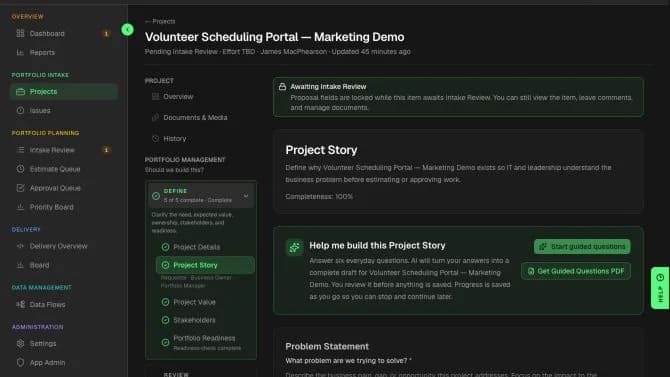
Precision Foundry is the place a technical lead can refuse a slogan. Guided questions collect the current path, the people, the first-release outcome, and the constraints on one record—so estimates attach to a boundary, not a meeting memory.
Common questions
Refuse to estimate a slogan. Write the current path, who is stuck, the first-release outcome, what is out of scope, and who can answer follow-up questions. If a stakeholder cannot name those facts, the scope is not clear yet.
Ask what happens today, who is stuck, what should be different after the first release, what is deliberately out of scope, who owns follow-up questions, and which timing or policy limits cannot move. Those six questions are the estimate gate.
No. A kickoff that starts with a solution name produces alignment theater. The meeting is useful only if it leaves a written current path, a first-release outcome, and named exclusions. Otherwise you scheduled another reconstruction.
That disagreement is the scope. Do not average it into a vague “phase 1.” Record the conflict, keep the estimate closed, and send the exclusion row back until someone can own a yes or a no.
This page is elicitation: pulling a usable first-release boundary out of stakeholders before anyone estimates. Stopping scope creep is what you do after that boundary exists—when new work tries to enter a sprint. Do not skip the first job.
Yes. Use the tracker after the organization can point at the written outcome and the exclusions. Precision Foundry is built for the stretch before those issues are trustworthy: the story, the questions, and the estimate against a named boundary.
Precision Foundry keeps this guide attached to the request so the template does not live in a forgotten doc.
Request Private AlphaOptional cookies
We use optional technologies only with your choice. Strictly necessary cookies for sign-in and security always run. Cookie Policy