
The request named a product, not a first release
“We need a portal” has no edge. Every adjacent idea sounds like part of the same project once development starts.
Scope before sprints
Scope creep that shows up in sprint planning was usually decided earlier—when the request had no exclusions, no reviewed requirements, and no recorded yes. Stop it by freezing the first-release outcome before anyone opens a sprint.
For IT leads, department owners, Scrum Masters, and anyone who watches sprint planning absorb work that was never approved.
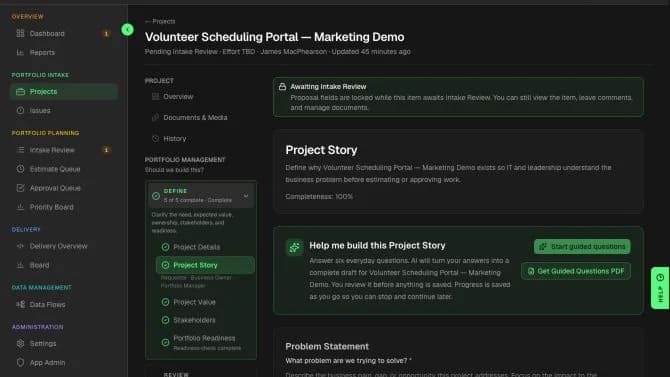
Scope is ready for sprint planning when
By the time developers are slicing stories, the organization has often implied a much larger system than anyone funded. New “quick adds” feel cheap because the original ask was a solution slogan. Scope creep is not mainly a facilitation problem. It is a missing gate between a business problem and a sprint-ready backlog.
“We need a portal” has no edge. Every adjacent idea sounds like part of the same project once development starts.
If nothing is explicitly out of scope, reviewers cannot point to a decision when a new report, role, or integration appears.
Opening a sprint to “figure it out” trains the team to invent scope in the same place they are supposed to commit to it.
Treat sprint planning as the place you sequence approved work—not the place you decide what the organization is buying. The same rule holds in Scrum: the Sprint Backlog may change to meet the Sprint Goal, not to invent new product scope. The gate below can be run by a department owner and an IT lead. It does not require a project manager in every meeting.
A complete request from software project intake is what makes the first-release outcome and its exclusions reviewable before anyone opens a backlog.
Freeze the answers that change behavior in requirements gathering software so sprint planning slices approved work instead of inventing the product.
Park a mid-sprint add until it returns through software project intake or a later increment—do not drop it into the current sprint because the team is already assembled.
Do not let a requested feature list become the project. Capture what is broken and what “better” means.
A volunteer scheduling request should say who cannot get shifts covered and what a successful season looks like. It should not start as a list of calendar widgets. Feature lists expand; outcomes can be tested.
Record what is in scope and what is deliberately out of scope for the first delivery.
Out of scope is the anti-creep tool. “Historical data migration is out of scope for launch” is a decision. If a later sprint needs that work, it is a new request or a later increment—not a silent add.
Use discovery to settle people, information, rules, and integrations that would alter the build if answered later.
Unanswered access rules, notification behavior, or “must stay unchanged” constraints become mid-sprint inventions. Visible open questions are safer than assumed answers.
If training, process change, or a second system appears during estimation, it is scope—not a footnote.
A technical estimate that assumes “users will just know” and a business estimate that assumes “IT will handle rollout” are two different projects. Reconcile them before approval.
Approval should cite the outcome, the exclusions, and the remaining unknowns. Then—and only then—create sprint work.
Sprint planning pulls from approved requirements and stories. New ideas go back to intake or a later increment. That is how you stop scope creep before developer sprint planning, instead of managing it inside the sprint.
The Sprint Backlog may be adjusted to meet the goal. It may not become the inbox for new product scope.
Write the Sprint Goal before the first ticket is pulled. Refuse mid-sprint product scope in the Daily Scrum—thank the requester and park the idea on the Product Backlog. If the new work must replace committed work, the Product Owner and developers renegotiate the goal in the open. Silent ticket adds are how Scrum becomes an open queue.
Practical template
If a row fails, do not open the sprint to invent the answer. Send the request back one step. The examples use a fictional client intake change.
Pre-sprint scope checklist
If this is missing
The team will optimize for whatever is loudest in the room.
Example of “ready”
Staff can submit a complete client request and see its status. Public self-service is later.
If this is missing
Unwritten exclusions become implied inclusions during refinement.
Example of “ready”
No historical import, no mobile app, no customer-facing status page in the first release.
If this is missing
Unreviewed drafts are still open to reinterpretation.
Example of “ready”
Access, workflow, and reporting answers are reviewed. Two integration questions remain listed.
If this is missing
Hidden uncertainty becomes a mid-sprint design change.
Example of “ready”
Legal has not confirmed retention wording; launch copy will use the current policy until they do.
If this is missing
A build-only number invites “just add training / just add a report.”
Example of “ready”
Business effort includes supervisor training; technical effort excludes a data warehouse feed.
If this is missing
Without a decision record, every stakeholder can reopen the boundary.
Example of “ready”
Approved for the first-release outcome above. Reporting dashboard is a separate request.
If this is missing
Orphan tickets are how quiet scope enters the sprint.
Example of “ready”
Each story maps to a reviewed requirement. “Nice to have export” is parked, not committed.
| Check | If this is missing | Example of “ready” |
|---|---|---|
| First-release outcome | The team will optimize for whatever is loudest in the room. | Staff can submit a complete client request and see its status. Public self-service is later. |
| Explicit exclusions | Unwritten exclusions become implied inclusions during refinement. | No historical import, no mobile app, no customer-facing status page in the first release. |
| Reviewed requirements | Unreviewed drafts are still open to reinterpretation. | Access, workflow, and reporting answers are reviewed. Two integration questions remain listed. |
| Open decisions named | Hidden uncertainty becomes a mid-sprint design change. | Legal has not confirmed retention wording; launch copy will use the current policy until they do. |
| Both estimates submitted | A build-only number invites “just add training / just add a report.” | Business effort includes supervisor training; technical effort excludes a data warehouse feed. |
| Recorded approval | Without a decision record, every stakeholder can reopen the boundary. | Approved for the first-release outcome above. Reporting dashboard is a separate request. |
| Stories trace to the approval | Orphan tickets are how quiet scope enters the sprint. | Each story maps to a reviewed requirement. “Nice to have export” is parked, not committed. |
Worked example
A fictional Client Intake Portal is approved as “staff can submit and track a request.” Before sprint planning, three extras appear. Only one belongs in the first release—and only if the approval is updated.
Where scope usually leaks before the first sprint
What happened
Staff submit a complete request and see status
What happened
A director asks for a public status page—out of scope unless re-approved
What happened
IT adds a warehouse feed “while we are in there”—new technical scope
What happened
Operations wants historical cleanup in week one—business scope, not a ticket tweak
What happened
Park all three, or reopen the decision with new estimates
What happened
Drop them into sprint 1 because the team is already assembling
| Moment | What happened |
|---|---|
| Approved outcome | Staff submit a complete request and see status |
| Leak 1 | A director asks for a public status page—out of scope unless re-approved |
| Leak 2 | IT adds a warehouse feed “while we are in there”—new technical scope |
| Leak 3 | Operations wants historical cleanup in week one—business scope, not a ticket tweak |
| Correct move | Park all three, or reopen the decision with new estimates |
| Incorrect move | Drop them into sprint 1 because the team is already assembling |
The discipline is boring: point at the written boundary. If the extra work is important, it earns its own estimate and decision. That conversation is cheaper before sprint planning than after developers have committed.
What was approved vs. what leaked into sprint planning
What appeared before the first sprint
A public status page “the director will love”
What appeared before the first sprint
A warehouse feed “while we are in there”
What appeared before the first sprint
Historical cleanup treated as a ticket tweak
What appeared before the first sprint
Three new stories invented in planning because the team is assembling
| What the yes covered | What appeared before the first sprint |
|---|---|
| Staff submit a complete request and see status | A public status page “the director will love” |
| First release only, with named exclusions | A warehouse feed “while we are in there” |
| A recorded decision on the first-release outcome | Historical cleanup treated as a ticket tweak |
| Stories that trace to the approval | Three new stories invented in planning because the team is assembling |
Stories are a poor place to decide who a user is or what “complete” means. Those answers belong in intake and requirements review.
An epic without an exclusion list is a container for future invention. Name the first milestone and what it will not include.
Adjacent technical work feels efficient and is still unapproved scope. Record it as a follow-on request.
If training, communication, or data cleanup is assumed, the sprint will absorb it as unplanned work or the launch will stall.
Standup inspects progress toward the Sprint Goal. Accepting a new report there trains the organization to treat Scrum as an open queue.
In Precision Foundry
Precision Foundry starts with the gate: story, discovery, dual estimates, and a recorded decision. Delivery then continues in the same product—requirements, stories, tasks, the sprint board, testing, and release—instead of inventing the project in another tracker.
Common questions
Write the first-release outcome and the exclusions, review the requirements that change behavior, estimate business and technical effort against that boundary, and record approval. Create sprint work only from that approved set. New ideas become a later increment or a new request.
Write a Sprint Goal, keep the Sprint Backlog limited to work that serves that goal, and send mid-sprint ideas to the Product Backlog. Change the increment only by renegotiating the goal with the developers. Do not accept new product scope in the Daily Scrum.
It shows up there, but it usually starts earlier: a vague request, no exclusions, unreviewed requirements, or tickets opened to discover the work. In Scrum it also shows up when the Daily Scrum becomes an inbox. Fix the gate before the sprint, not only the facilitation during it.
Treat it as a change to the decision. Re-estimate the impact on both the business and technical sides, then record a new yes, no, or not yet. If you run Scrum and the work must replace committed work, rewrite the Sprint Goal in the open. Do not silently fold it into the current sprint.
Protect the Sprint Goal. Ask the Product Owner to place the idea on the Product Backlog. If the work must happen now, facilitate a visible swap: something leaves the sprint and the goal is rewritten.
Yes. Use the tracker after the organization knows what it approved. Precision Foundry is built for the stretch before those issues are trustworthy: the story, the questions, both estimates, and the decision.
Precision Foundry keeps this guide attached to the request so the template does not live in a forgotten doc.
Request Private AlphaOptional cookies
We use optional technologies only with your choice. Strictly necessary cookies for sign-in and security always run. Cookie Policy