
The document starts at a solution
A preferred vendor or architecture hides the problem. Reviewers cannot tell what the business actually needs.
Business requirements
A business requirements document states why a software change is worth doing: the current problem, who is affected, the outcome that would make the work succeed, and the constraints that already apply. It is not a design, a backlog, or a launch date. Write it from the original request and keep it reviewable.
For department leads and reviewers who were asked for a BRD and do not want a document nobody reads.
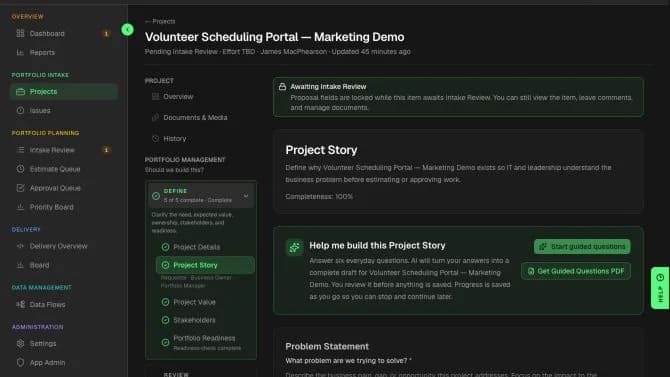
A usable BRD includes
Teams search how to write a BRD because someone asked for a document. The usual result is a 40-page file that invents scope, then ages in SharePoint while tickets become the real spec. A BRD should be a view of the reviewed business answers on the original request.
A preferred vendor or architecture hides the problem. Reviewers cannot tell what the business actually needs.
Once the BRD exists, nobody opens what the requestor wrote. The spec splits on day one.
Dates, phases, and a WBS do not belong here. Those come after both sides can estimate a first release.
A BRD answers why this software change exists. How it will be built belongs in a later PRD or in reviewed technical answers. Keep both on the same request.
A BRD written from a slogan is fiction. Finish software project intake so the problem, people, and owner already exist.
Keep the business answers in requirements gathering software instead of retiring the request when the PDF is exported.
If finance asked for a document, generate it from requirements gathering software after the answers are reviewed—not from a blank template.
Open what the requestor already said about today, the people, and the owner. Do not start a blank template.
If that story is incomplete, finish intake. A BRD written from a slogan is fiction with better formatting.
Name the current process, the pain, and what happens if nothing changes.
‘Volunteers quit after a three-day setup’ is a business requirement. ‘Build a mobile app’ is a solution.
Write what should be different, not the feature list that might cause it.
A testable outcome gives later estimates something to size. A feature wishlist does not.
Policy, vendors, busy seasons, and what is out of the first release belong in the BRD.
Exclusions are how a BRD prevents gold-plating. If everything is in scope, nothing is.
Publish the document as a view of reviewed answers. Do not retire the request when the PDF exists.
When a decision changes, update the source the same day. A dated BRD beside a live backlog is how the spec dies.
PRD vs BRD is the order people search when they have been asked for both files. A BRD states why the software change is worth doing. A PRD states what the first release should do to meet that why. Write the BRD first. If the PRD invents a new problem, you restarted intake under a product-document name.
Practical template
Copy these sections. Leave unknown as unknown. The examples are fictional.
BRD outline you can finish without a PMO
Why it is here
The BRD is worthless if it starts at a product name.
Complete answer
Staff plan events over three days using email and a spreadsheet.
Why it is here
Business value has a human, not a system name.
Complete answer
Tournament staff, volunteers, and facility coordinators.
Why it is here
Estimates need a first-release result.
Complete answer
The same event can be run in two days with fewer facility changes.
Why it is here
Someone must defend the outcome when scope appears.
Complete answer
Jordan Lee, operations manager.
Why it is here
Hard limits belong before anyone designs.
Complete answer
Fall registration is off limits. Payment vendor stays.
Why it is here
A BRD without exclusions is a wishlist.
Complete answer
No public parent app in the first release.
Why it is here
Later tests need a business check, not only a ticket.
Complete answer
Average setup drops from three days to two.
| Section | Why it is here | Complete answer |
|---|---|---|
| Problem today | The BRD is worthless if it starts at a product name. | Staff plan events over three days using email and a spreadsheet. |
| People affected | Business value has a human, not a system name. | Tournament staff, volunteers, and facility coordinators. |
| Outcome | Estimates need a first-release result. | The same event can be run in two days with fewer facility changes. |
| Owner | Someone must defend the outcome when scope appears. | Jordan Lee, operations manager. |
| Constraints | Hard limits belong before anyone designs. | Fall registration is off limits. Payment vendor stays. |
| Out of scope | A BRD without exclusions is a wishlist. | No public parent app in the first release. |
| How we will know | Later tests need a business check, not only a ticket. | Average setup drops from three days to two. |
Worked example
Operations asked for a document finance would recognize. The useful BRD was the reviewed answers, exported once—not a second living file.
A BRD that stayed attached to the request
What we recorded
The original software request, not a blank template
What we recorded
Three-day event setup over email
What we recorded
Two-day setup with the same payment vendor
What we recorded
No parent-facing app in the first release
What we recorded
Operations manager who can answer this week
What we recorded
Architecture, epics, and a launch date
What we recorded
On the request; PDF is a snapshot
| Check | What we recorded |
|---|---|
| Source | The original software request, not a blank template |
| Problem | Three-day event setup over email |
| Outcome | Two-day setup with the same payment vendor |
| Exclusion | No parent-facing app in the first release |
| Owner | Operations manager who can answer this week |
| What we skipped | Architecture, epics, and a launch date |
| Where it lives | On the request; PDF is a snapshot |
A BRD succeeds when a leader can approve the why without pretending the how is already known. Keep it on the request so it cannot age in a folder.
A stale BRD file versus a reviewable business record
Reviewable BRD on the request
Answers taken from the original request
Reviewable BRD on the request
The current process and the people who hurt
Reviewable BRD on the request
An outcome and the constraints that already apply
Reviewable BRD on the request
The same record later stories and tests can open
| Slide-deck business case | Reviewable BRD on the request |
|---|---|
| A 40-page template filled after the hallway yes | Answers taken from the original request |
| A preferred vendor in the first paragraph | The current process and the people who hurt |
| A launch date treated as a requirement | An outcome and the constraints that already apply |
| A PDF that nobody updates after sprint one | The same record later stories and tests can open |
How it will be built belongs after the why is reviewed. A BRD that names a stack is a design document in costume.
Tickets are not business requirements. If you need a story list, you are writing a PRD or inventing work too early.
When the business learns something, update the source. A frozen file beside a live product is how requirement drift starts.
They can describe the outcome. Testable criteria come after questions, not as homework on the BRD cover sheet.
In Precision Foundry
The outline above is the document. The product stores the same answers on the original request so a PDF is a snapshot, not a second source of truth.
Common questions
Start from a complete software request. Write the current problem, the people affected, the outcome that would make the change worth doing, the owner, constraints, and exclusions. Stop before architecture, tickets, or a launch date. Keep the BRD on that request so it can be updated.
PRD vs BRD is an order question. A BRD states why the change exists. A PRD states what the product should do to meet that why. Write the BRD first. Do not let the PRD invent a new business problem.
No. A short BRD that a stranger can review is better than a long file nobody opens. Missing architecture is expected. Missing who is affected is not.
The requestor drafts the why. A reviewer checks completeness. You do not need a BA to name the current process and the people who hurt.
The source should live on the request. Export a document when someone outside the team needs a snapshot. Do not maintain two originals.
Precision Foundry keeps this guide attached to the request so the template does not live in a forgotten doc.
Request Private AlphaOptional cookies
We use optional technologies only with your choice. Strictly necessary cookies for sign-in and security always run. Cookie Policy