
The ask is a slogan
“We need an app” is a solution. Reviewers still have to recover the broken week.
Project request form
A project request form is how a department manager asks for a software change without sending an email slogan. It collects the current process, the people who hurt, a reachable owner, and known limits—then Intake Review brings in an IT Owner before discovery begins.
For department managers who need to request software from IT, and for reviewers who are tired of reconstructing hallway asks.
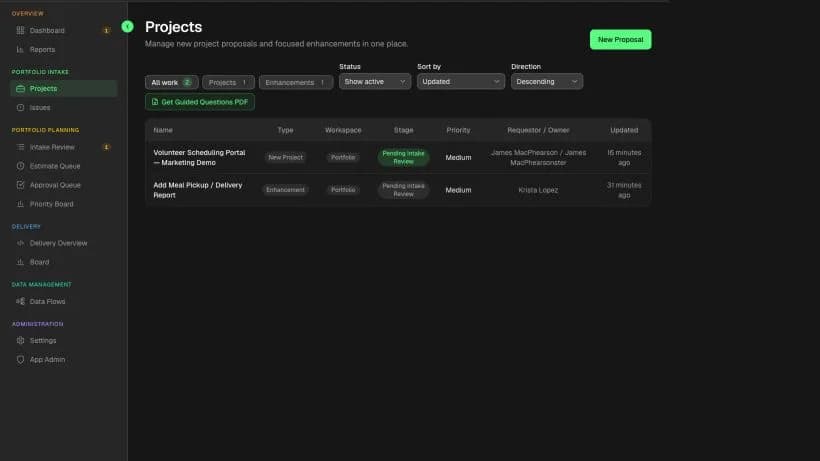
A usable IT project request form captures
How to request software from IT is usually: send a chat, book a meeting, or open a ticket. None of those produce a story a stranger can retell. An IT project request form exists so the ask is written once and reviewed once.
“We need an app” is a solution. Reviewers still have to recover the broken week.
Email and chat hide what is waiting, what is incomplete, and what already has a no.
A service-desk subject line is for access and catalog work. A software change still needs a story.
How to write a software request is the same method as filling the form: describe today, name the people, attach an owner, and write the limits. Intake Review and IT Triage come next; a BA facilitates the selected discovery path, and estimates follow those shared answers.
The form is the front door. Put the finished story on software project intake so a reviewer can read it once.
Once the request is understandable, requirements gathering software keeps the follow-up questions on that same record.
If today’s request is still a hallway slogan, start with software project intake instead of a ticket.
Start with the current process and the people who feel the pain. Do not start with a vendor or a feature list.
“Staff book rooms in email and a spreadsheet, and volunteers give up after three days” is a request. “We need a scheduling platform” is a slogan.
Someone in the department must answer follow-up questions while the story is still fresh.
Owner is not a project manager. If nobody will pick up the phone, the form is not finished.
Busy seasons, vendors that cannot move, and policies belong on the form.
Unknown is allowed. An invented go-live date is not. Constraints are facts.
A reviewer checks completeness, then an IT Owner recommends Standard Discovery, Lightweight Discovery, Existing Solution Review, or Not an IT Project.
Security, Vendor, Data, and Architecture reviews are flagged only when needed. Ready for Discovery opens the recommended path; it is not investment approval.
An IT project request form is for software change. Events and office workflows need a different tool.
If the ask is a launch calendar or a hiring queue, stop. This form will treat it as a system change and waste a review.
A project request form is the generic front door people search. For software change it still has to collect a current process, the people affected, a reachable owner, and known limits. A form that also accepts events, hiring, and office workflows will hide the software ask in a mixed queue.
A software request form is the same job in department-manager words: write what happens this week, who is stuck, who will answer follow-up, and what cannot move. Then stop. A ticket title, a vendor name, or a feature list is not that form.
A software change request form is not an ITIL CAB packet. It collects the current process, the people who hurt, a reachable owner, and known limits so IT can review a system change. Access, incidents, and catalog work belong on a service desk. Campaigns belong somewhere else.
A change request in project management belongs on the approved request it would alter. Record the proposed difference, why it appeared, which outcome or exclusion changes, the added business and technical effort, and who accepts the tradeoff. Do not open a second intake record and pretend the original commitment remained untouched.
An internal software request portal is the employee front door for a system change. If the same portal also accepts events, hiring, and office workflows, the software ask disappears in a mixed queue. Keep this portal for software change only.
Intake Review brings an IT Owner into the process before discovery. IT recommends one of four routes and identifies any Security, Vendor, Data, or Architecture review. A Approver may then mark the request Ready for Discovery; one BA facilitates the selected questions, and investment approval waits for the Business and IT estimates.
Practical template
Collect only what a reviewer needs to understand the software change. Extra architecture fields hide the problem.
Project request form fields that change a decision
Why it exists
Reviewers need today, not a product name.
Done looks like
Reservations happen in email and a shared spreadsheet.
Why it exists
A request without a human is a slogan.
Done looks like
Front-desk staff, volunteers, and facility coordinators.
Why it exists
Follow-up questions need a name.
Done looks like
Jordan Lee, operations, will answer this week.
Why it exists
Busy seasons and vendors change the first release.
Done looks like
Cannot launch during fall registration. Payment vendor stays.
Why it exists
Better has to be testable later.
Done looks like
A volunteer can confirm a shift without a three-day email wait.
Why it exists
Campaigns and access requests leave this form.
Done looks like
Not a help-desk ticket. Not a marketing launch.
| Field | Why it exists | Done looks like |
|---|---|---|
| Current process | Reviewers need today, not a product name. | Reservations happen in email and a shared spreadsheet. |
| People affected | A request without a human is a slogan. | Front-desk staff, volunteers, and facility coordinators. |
| Reachable owner | Follow-up questions need a name. | Jordan Lee, operations, will answer this week. |
| Known constraints | Busy seasons and vendors change the first release. | Cannot launch during fall registration. Payment vendor stays. |
| Intended outcome | Better has to be testable later. | A volunteer can confirm a shift without a three-day email wait. |
| What this is not | Campaigns and access requests leave this form. | Not a help-desk ticket. Not a marketing launch. |
Worked example
Operations wanted a volunteer app. The form turned that slogan into a request IT could read without a kickoff.
A department ask that became a reviewable request
What we recorded
Volunteer coordinator who runs seasonal events
What we recorded
Three-day setup over email and a spreadsheet
What we recorded
Staff, volunteers, and facility coordinators
What we recorded
Operations manager reachable the same week
What we recorded
Fall registration week is off limits
What we recorded
A volunteer confirms a shift without the email pile
What we recorded
A vendor shortlist or a go-live date
| Check | What we recorded |
|---|---|
| Idea contact | Volunteer coordinator who runs seasonal events |
| Current process | Three-day setup over email and a spreadsheet |
| People | Staff, volunteers, and facility coordinators |
| Owner | Operations manager reachable the same week |
| Constraint | Fall registration week is off limits |
| Outcome | A volunteer confirms a shift without the email pile |
| What we did not write | A vendor shortlist or a go-live date |
The form succeeded when a reviewer could understand the ask without the requestor in the room. That is how to request software from IT—write it, then stop.
Hallway asks versus an IT project request form
IT project request form
One written story a stranger can retell
IT project request form
Current process, people, owner, and limits on one record
IT project request form
A completeness check before anyone books time
IT project request form
Software change only; other work leaves this form
| Email-and-hallway request | IT project request form |
|---|---|
| A chat slogan that becomes a meeting | One written story a stranger can retell |
| A ticket title pretending to be the request | Current process, people, owner, and limits on one record |
| A kickoff that invents the problem in the room | A completeness check before anyone books time |
| Campaigns and software changes in the same pile | Software change only; other work leaves this form |
Vendor names and architecture hide what is broken. Ask what happens today before you invite a feature list.
Access requests and catalog items belong in a ticket. A software change still needs a story and a decision.
How to write a software request does not require epics, points, or a glossary. Everyday words are the input.
If you need a room to understand the ask, the form did not run.
In Precision Foundry
The method above is operational: write the request, review it with IT, route discovery, then decide later with both estimates. Precision Foundry stores that same thread so the BA-facilitated questions still open what the requestor wrote.
Common questions
An IT project request form is a written front door for a software change. It collects the current process, the people affected, a reachable owner, and known limits so a reviewer can understand the ask without a kickoff.
Write what happens today, who is stuck, who will answer questions, and what cannot move. Submit that once. Do not open a ticket or book a meeting to invent the story.
Describe the current week in everyday words. Name the people. Attach an owner. Write constraints. Stop before you prescribe a vendor or a feature list.
No. A service-desk form is for frontline support, access, and catalog items. An IT project request form is for a software change that still needs a story and a decision.
The person closest to the broken process submits the initial request. They do not need project-management vocabulary. An IT Owner handles early triage, and one BA facilitates the later discovery questions and records answers for Business and IT. A leader records the investment decision after both estimates exist.
Precision Foundry keeps this guide attached to the request so the template does not live in a forgotten doc.
Request Private AlphaOptional cookies
We use optional technologies only with your choice. Strictly necessary cookies for sign-in and security always run. Cookie Policy