
No dedicated translator
The person with the problem and the person building the change need a shared record. A small team cannot schedule a project manager into every conversation.
software delivery management for small teams
Software delivery management for small teams should connect the request, questions, estimates, decision, requirements, sprint work, testing, and release without requiring a project office or a stack of specialist tools.
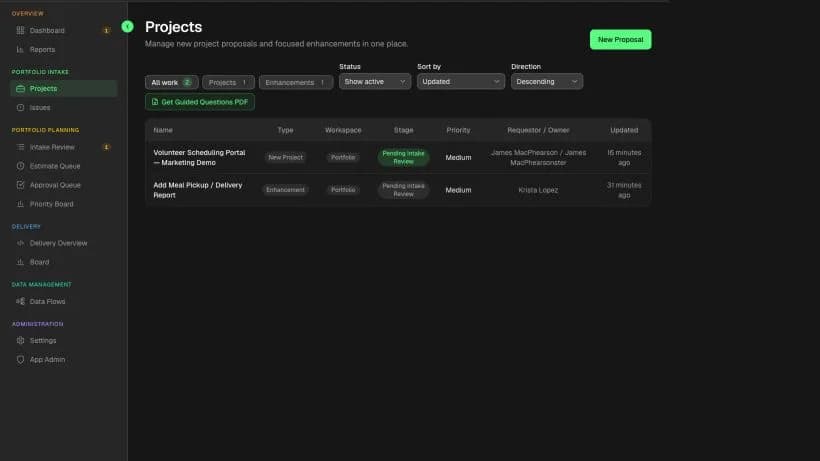
Small-team SDM should remove
A five-person team cannot staff a PMO, requirements office, release office, and platform-administration group. When intake lives in forms, requirements in documents, delivery on a board, and testing in a spreadsheet, the team spends its limited capacity reconstructing context.
The person with the problem and the person building the change need a shared record. A small team cannot schedule a project manager into every conversation.
Copying a request into a requirements document and then into a backlog produces three versions of the same software change.
Complex configuration and specialist vocabulary turn a useful lifecycle into another system nobody has time to maintain.
Precision Foundry fits when process gaps—not missing enterprise infrastructure—are causing rework.
Department managers and operational experts need to explain a software problem without writing epics or acceptance criteria.
Training, communications, data cleanup, adoption, and process change must sit beside the technical estimate.
Requirements, delivery work, tests, and release evidence should stay traceable to the original software request.
Keep the workflow narrow: understand one software change, decide whether it deserves capacity, and deliver the approved boundary without rewriting it.
Capture the current process, affected people, owner, constraints, and intended outcome in everyday language.
Business and IT estimates stay separate: Business sizes training and process change, IT sizes the build, and a leader records yes, no, or not yet against both sides.
Requirements, stories, sprint work, testing evidence, and release readiness stay attached to the request that earned the yes.
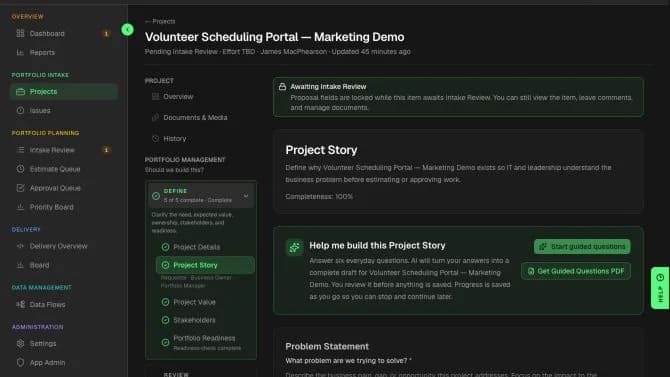
In the product
The team does not paste a request into a new requirements document and another backlog. Reviewed answers become the delivery context people can still open during testing.
Results
A small team gets lifecycle discipline without recreating an enterprise project office. Everyone can see what was requested, what was approved, what is being built, and what evidence supports release.
Common questions
It is a connected way to move a software change from request through discovery, estimation, approval, requirements, delivery, testing, and release without requiring separate specialist teams for every stage.
No. Requestors write in everyday language, and guided questions help fill gaps. Someone still owns the decision and the work, but a project manager is not required to translate every step.
Yes. Delivery can stay in Precision Foundry, or Jira can remain the engineering work-item system when the team already depends on it. The important boundary is that an unvetted request should not begin as a backlog item.
No. Task management coordinates assigned work. Software delivery management preserves the software decision from the original request through requirements, testing, and release.
Start with a request in everyday language and keep the approved change connected through requirements, sprints, testing, and release.
Request Private AlphaOptional cookies
We use optional technologies only with your choice. Strictly necessary cookies for sign-in and security always run. Cookie Policy