
The starting point is hidden
Some products begin with a business request. Others begin with a backlog, delivery telemetry, or a release portfolio that already exists.
software delivery management tools
Software delivery management tools can mean request-to-release workflow, enterprise agile lifecycle management, engineering predictability, or release coordination. Compare the starting point and operating model before comparing feature lists.
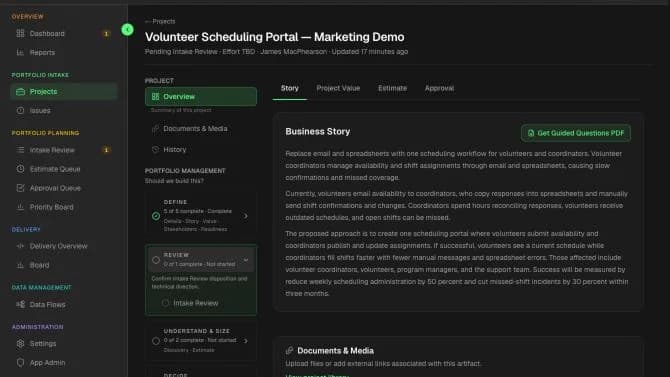
A useful SDM tools comparison separates
Software delivery tools are not interchangeable. A team that cannot turn a department request into approved software work does not have the same problem as an engineering leader forecasting delivery risk or an enterprise quality organization running thousands of tests. A feature count hides that difference.
For the category definition—not a tools shortlist—start with software delivery management. This page compares SDM tools by starting point and operating model after you know which job you are buying for.
Some products begin with a business request. Others begin with a backlog, delivery telemetry, or a release portfolio that already exists.
A product can carry work itself or analyze work held in Jira, Azure DevOps, repositories, and deployment systems. Those operating models require different adoption decisions.
Formal quality engineering, compliance, and release orchestration are valuable when required. A smaller team may instead need one understandable path without an implementation program.
Match the product to the unresolved job. This table compares documented product scope; it is not a ranking.
Software delivery management tools at a glance
Best for
Internal software change that must move from a plain-language request through approval and release.
Starts with
A business problem, the people affected, a reachable owner, constraints, and an intended outcome.
Planning and decisions
Guided questions, separate Business and IT estimates, portfolio tradeoffs, a recorded yes or no, and epic sequencing.
Delivery and quality
Requirements, stories, a sprint board, testing evidence, production issues, and release stay on the original request thread.
Operating model
Cloud SaaS with native intake-to-release workflow. Jira can remain an optional work-item system rather than a required data source.
Best for
Enterprise agile lifecycle management and quality engineering across teams and toolchains.
Starts with
Agile plans, backlogs, requirements, tests, releases, and connected DevOps systems.
Planning and decisions
Agile planning across backlogs, sprints, epics, release trains, and scaled programs.
Delivery and quality
Integrated testing, automation, traceability, compliance support, release management, and CI/CD connections.
Operating model
A scalable enterprise ALM and quality platform with cloud, managed, and on-premises deployment options documented by OpenText.
Best for
Engineering leaders who need capacity forecasting, delivery predictability, and risk visibility from existing execution data.
Starts with
Planning and execution data from work trackers and source-control systems already used by engineering teams.
Planning and decisions
Capacity plans, scenario modeling, staffing and scope tradeoffs, and forecasts based on historical performance.
Delivery and quality
Delivery-risk projections, alerts, and roadmap-to-release visibility rather than a native requirements and test-management lifecycle.
Operating model
An intelligence layer that connects to Jira, Azure DevOps, Linear, GitHub, GitLab, Bitbucket, and other engineering systems listed by Jellyfish.
Best for
Enterprise release management, environment management, deployment planning, and value-stream visibility.
Starts with
Release portfolios, delivery systems, environments, dependencies, and deployment activity across teams.
Planning and decisions
Release planning, dependency coordination, environment scheduling, and portfolio-level delivery visibility.
Delivery and quality
Release governance, deployment coordination, delivery analytics, and value-stream reporting across an existing toolchain.
Operating model
An enterprise coordination and analytics layer for organizations managing software delivery across multiple systems and teams.
| Tool | Best for | Starts with | Planning and decisions | Delivery and quality | Operating model |
|---|---|---|---|---|---|
| Precision Foundry | Internal software change that must move from a plain-language request through approval and release. | A business problem, the people affected, a reachable owner, constraints, and an intended outcome. | Guided questions, separate Business and IT estimates, portfolio tradeoffs, a recorded yes or no, and epic sequencing. | Requirements, stories, a sprint board, testing evidence, production issues, and release stay on the original request thread. | Cloud SaaS with native intake-to-release workflow. Jira can remain an optional work-item system rather than a required data source. |
| OpenText Software Delivery Management (official product page) | Enterprise agile lifecycle management and quality engineering across teams and toolchains. | Agile plans, backlogs, requirements, tests, releases, and connected DevOps systems. | Agile planning across backlogs, sprints, epics, release trains, and scaled programs. | Integrated testing, automation, traceability, compliance support, release management, and CI/CD connections. | A scalable enterprise ALM and quality platform with cloud, managed, and on-premises deployment options documented by OpenText. |
| Jellyfish Planning & Delivery (official product page) | Engineering leaders who need capacity forecasting, delivery predictability, and risk visibility from existing execution data. | Planning and execution data from work trackers and source-control systems already used by engineering teams. | Capacity plans, scenario modeling, staffing and scope tradeoffs, and forecasts based on historical performance. | Delivery-risk projections, alerts, and roadmap-to-release visibility rather than a native requirements and test-management lifecycle. | An intelligence layer that connects to Jira, Azure DevOps, Linear, GitHub, GitLab, Bitbucket, and other engineering systems listed by Jellyfish. |
| Plutora (official product page) | Enterprise release management, environment management, deployment planning, and value-stream visibility. | Release portfolios, delivery systems, environments, dependencies, and deployment activity across teams. | Release planning, dependency coordination, environment scheduling, and portfolio-level delivery visibility. | Release governance, deployment coordination, delivery analytics, and value-stream reporting across an existing toolchain. | An enterprise coordination and analytics layer for organizations managing software delivery across multiple systems and teams. |
Last reviewed: August 2026
We reviewed each vendor's official product pages in August 2026. Cells describe the primary job and capabilities those pages publish. No review scores, customer rankings, or unsupported price and implementation claims are used.
Choose the category that owns your unresolved problem before comparing individual capabilities.
The software request is still incomplete. Business and IT need guided discovery, separate estimates, a recorded decision, and one thread through testing and release.
Multiple teams need deep planning, quality engineering, automated testing, traceability, compliance, and DevOps integrations at scale.
Work already lives in engineering systems. Leaders need capacity forecasts, delivery-risk signals, and scenario planning without replacing those systems.
The organization needs to coordinate releases, environments, dependencies, and deployments across an established enterprise toolchain.
A shortlist becomes useful when every tool must show how it handles the same starting conditions and required end state.
State whether the organization has an incomplete request, a trustworthy backlog, a forecasting problem, or a release-coordination problem.
Ask each vendor to show where the item begins, which decisions are native, where quality evidence lives, and what must remain in another system.
List required integrations, administrators, migrations, and companion products. The operating model matters as much as the feature list.
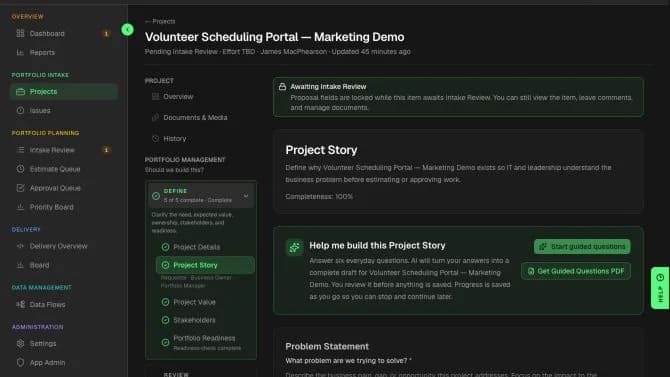
In the product
The request, guided answers, both estimates, and recorded decision become the requirements and delivery work. That starting point separates Precision Foundry from delivery-intelligence and release-coordination platforms.
Results
A job-based comparison produces a shorter, more honest shortlist and prevents a small team from buying enterprise depth—or an enterprise program from buying a lightweight workflow—that cannot own its real problem.
Common questions
Software delivery management tools are products inside the broader software delivery management category. They coordinate some or all of the path from a software idea through planning, execution, quality, and release—native lifecycle systems, enterprise ALM, engineering-intelligence layers, or release-coordination products. Compare the operating model before you compare feature lists.
Software delivery tools may solve one part of the lifecycle, such as backlog planning, engineering intelligence, automated testing, or release coordination. An SDM platform connects multiple stages and preserves the decisions and evidence between them. Buyers should decide whether they need a focused tool, an analytics layer, or a native request-to-release system before comparing features.
No. The best fit depends on the unresolved job. Precision Foundry fits an internal request that still needs discovery and a decision. Other products focus on enterprise quality engineering, forecasting from existing delivery data, or coordinating complex releases.
Some can run delivery work natively, while others depend on Jira or another tracker as a data source. Precision Foundry can carry approved work through release, and Jira can remain optional when engineering already requires it.
A small team should require a clear starting workflow, understandable language, minimal administration, and lifecycle coverage it will actually use. Enterprise scale and integration breadth are not benefits when they create work the team cannot support.
See Precision Foundry when a business request still needs questions, Business and IT estimates, a recorded decision, and delivery on one thread.
Request Private AlphaOptional cookies
We use optional technologies only with your choice. Strictly necessary cookies for sign-in and security always run. Cookie Policy