
DoR is applied to the wrong artifact
The checklist lives on a Jira story. The missing facts live in someone’s head, a slide, or a Slack thread. You cannot automate a gate on a document that is already a rewrite.
Definition of Ready
A Definition of Ready for agile teams is not a Jira checklist, JQL filter, or Confluence template. It is a gate that blocks work until the request has a written problem, reviewed answers, both estimates, a recorded yes, and a delivery slice the team can actually build.
For team leads and Scrum Masters who want a Definition of Ready that actually blocks unfinished work—without turning Jira into a second intake form.
The DoR is theater when
Team leads search for automating the Definition of Ready because unfinished work keeps entering the sprint. The usual answer is a template: description filled, criteria written, points set, dependencies named. That is ticket hygiene. It does not decide whether the organization already bought a first release. A script that requires those fields will still pull a slogan that happens to have a number.
The checklist lives on a Jira story. The missing facts live in someone’s head, a slide, or a Slack thread. You cannot automate a gate on a document that is already a rewrite.
Sized, has criteria, has an owner. None of those prove the current process, the people blocked, or the exclusions were written down. The sprint then discovers the product.
If development is allowed as soon as a story exists, the Definition of Ready is a poster. Automation that does not block the next phase is documentation.
Automating the Definition of Ready is a translation job. Take the Scrum checklist the team already recites, and attach each item to a gate that can refuse the next phase. The early gate is the software request. The later gate is Delivery Planning—stories, acceptance criteria, tasks, and teams—before Development starts. Do not replace those gates with a Jira template.
The first gate is a finished request. Put the current path, the people, and a reachable owner on software project intake before anyone treats a story as ready.
Map “requirements understood” to reviewed answers in requirements gathering software so the Definition of Ready is not a comment on a ticket that already rewrote the ask.
If the story still has open answers that would change the build, keep them visible in requirements gathering software and refuse the pull. A green checklist cannot close an unknown.
A software discovery phase decides what the organization is buying. A story-level DoR decides whether that approved slice can be pulled.
If you only automate the story checklist, slogans still enter the backlog. Finish the written request, both estimates, and a recorded yes first. Ticket hygiene comes after that yes—not instead of it.
DoR item: the team understands the problem. Automation: the request names the current path, who is stuck, and the first-release outcome.
A title and a preferred widget fail this gate. “Volunteers give up after three days of email scheduling” passes. If a stranger cannot retell the week, the story is not ready—whatever the points say.
DoR item: requirements are clear. Automation: project-specific questions are answered or visibly open on the same record.
Open answers that would change the build stay listed. They are not assumed. A Confluence page that then gets pasted into Jira is a new document, not a gate.
DoR item: estimated, acceptance criteria written, owner named. Automation: stories, criteria, tasks, and teams pass readiness before Development unlocks.
This is the story-level Definition of Ready. Foundry already evaluates those areas. A story without criteria, or a task without an owner, keeps Development blocked. A Jira required-field script can mimic the stamp. It cannot keep the answers on the intake thread.
If the yes is missing, the story is not ready—even if the checklist is green.
Automating the Definition of Ready fails when sprint planning is allowed to invent the product. Park the story. Send the request back through intake and questions. The board is for approved slices, not archaeology.
Definition of ready agile searchers usually want a Scrum checklist they can automate. The useful version maps each recited item to a gate that can refuse the next phase: a finished intake, reviewed answers, both estimates, a recorded yes, then Delivery Planning readiness. A Jira required-field script can stamp a slogan. It cannot keep those facts on the original request.
Practical template
Use this as a translator, not as a Jira import. Each left-hand item is what team leads already recite. The middle column is the gate that can actually block work. The examples use a fictional volunteer scheduling request.
Definition of Ready checklist mapped to Foundry gates
Foundry gate that enforces it
A slogan is not a problem. The current path and who is stuck have to be written.
What “ready” looks like
Intake: volunteers wait three days on email. The workaround is a shared inbox. A stranger can retell that week.
Foundry gate that enforces it
Silence becomes a developer guess. Open questions must stay visible.
What “ready” looks like
Reviewed answers name who approves a last-minute facility change. Legal retention is listed as unknown, not assumed.
Foundry gate that enforces it
An unwritten “not now” is how the first increment becomes the wishlist.
What “ready” looks like
No public self-service, no mobile app, no historical import. The yes cites that boundary.
Foundry gate that enforces it
A code-only number is not a Definition of Ready for a change people must learn.
What “ready” looks like
Build hours sit next to trainer time and first-month backfill. Leaders recorded yes against both.
Foundry gate that enforces it
Criteria typed from memory in planning match the conversation, not the request.
What “ready” looks like
Each approved story has criteria pulled from a reviewed answer. Delivery Planning shows the gap if they do not.
Foundry gate that enforces it
A ready story with no team is a poster.
What “ready” looks like
Delivery teams are confirmed. Development stays blocked until the owner exists—not until someone volunteers in standup.
Foundry gate that enforces it
A hidden vendor or data constraint is how a “ready” story dies mid-sprint.
What “ready” looks like
The payment vendor stays. That constraint is on the intake thread, not in a comment on story 14.
| Typical DoR item | Foundry gate that enforces it | What “ready” looks like |
|---|---|---|
| The problem is understood | A slogan is not a problem. The current path and who is stuck have to be written. | Intake: volunteers wait three days on email. The workaround is a shared inbox. A stranger can retell that week. |
| Requirements are clear | Silence becomes a developer guess. Open questions must stay visible. | Reviewed answers name who approves a last-minute facility change. Legal retention is listed as unknown, not assumed. |
| Exclusions are named | An unwritten “not now” is how the first increment becomes the wishlist. | No public self-service, no mobile app, no historical import. The yes cites that boundary. |
| Business and technical size exist | A code-only number is not a Definition of Ready for a change people must learn. | Build hours sit next to trainer time and first-month backfill. Leaders recorded yes against both. |
| Stories have acceptance criteria | Criteria typed from memory in planning match the conversation, not the request. | Each approved story has criteria pulled from a reviewed answer. Delivery Planning shows the gap if they do not. |
| An owner can pull the work | A ready story with no team is a poster. | Delivery teams are confirmed. Development stays blocked until the owner exists—not until someone volunteers in standup. |
| Dependencies are visible | A hidden vendor or data constraint is how a “ready” story dies mid-sprint. | The payment vendor stays. That constraint is on the intake thread, not in a comment on story 14. |
Worked example
A fictional Volunteer Scheduling System story is marked ready because the Jira DoR checklist is green. Development starts. The week still is not written.
A “ready” story that was still a slogan
What was actually missing
“Build volunteer scheduling so staff are more efficient.”
What was actually missing
8 points. The first-release outcome was never written.
What was actually missing
“User can schedule a volunteer.” No definition of complete, no exclusions.
What was actually missing
The three-day email wait, the shared-inbox workaround, and “no public self-service.”
What was actually missing
Unreviewed answers, missing team confirmation, criteria that do not trace to a requirement.
What was actually missing
Return the story. Finish the request and the yes. Then let readiness unlock Development.
| What the checklist said | What was actually missing |
|---|---|
| Jira DoR: description filled | “Build volunteer scheduling so staff are more efficient.” |
| Jira DoR: story points set | 8 points. The first-release outcome was never written. |
| Jira DoR: acceptance criteria | “User can schedule a volunteer.” No definition of complete, no exclusions. |
| What intake still lacked | The three-day email wait, the shared-inbox workaround, and “no public self-service.” |
| What Delivery Planning would have blocked | Unreviewed answers, missing team confirmation, criteria that do not trace to a requirement. |
| The correction | Return the story. Finish the request and the yes. Then let readiness unlock Development. |
The checklist did its job: it proved the ticket had text. Automating the Definition of Ready has a different job: refuse work that cannot be retold, estimated on both sides, and owned. A green stamp on a slogan is how the sprint becomes discovery.
A Jira DoR checklist vs. a Foundry readiness gate
A Foundry readiness gate
A complete request, reviewed answers, and a recorded yes before stories exist
A Foundry readiness gate
Development stays locked until Delivery Planning readiness passes
A Foundry readiness gate
The same intake thread QA will open at verification
A Foundry readiness gate
A stranger can retell the week, or the work cannot be pulled
| A Jira DoR checklist | A Foundry readiness gate |
|---|---|
| Required fields on a story: description, points, criteria | A complete request, reviewed answers, and a recorded yes before stories exist |
| A JQL filter that hides tickets missing a DoR label | Development stays locked until Delivery Planning readiness passes |
| A Confluence template pasted into every epic | The same intake thread QA will open at verification |
| Hygiene that can pass on a slogan | A stranger can retell the week, or the work cannot be pulled |
Required fields raise the cost of creating a ticket. They do not produce a written problem, both estimates, or a yes. A smaller pile of raw tickets is still a pile of raw tickets.
Ticket hygiene is later. The discovery phase decides what the organization is buying. Do not skip the first job by stamping stories that never had a request.
If the next phase is not blocked, the Definition of Ready is a poster. Automation has to refuse the pull.
This page is a translator for people who already search for DoR. The product still speaks in requests, answers, and readiness—not in a glossary you have to teach the requestor.
In Precision Foundry
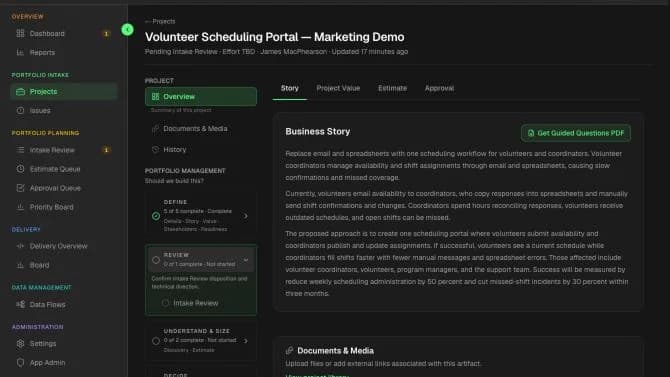
Precision Foundry already runs the gates team leads are trying to script. Intake review refuses an incomplete request. Dual estimates and a recorded yes sit on that record. Delivery Planning then evaluates requirements, stories, acceptance criteria, tasks, and teams before Development can start. The QA tester later opens the same data thread—not a Jira paraphrase that survived a checklist.
Common questions
It means work cannot be pulled until gates pass—not that a Jira template was applied. The early gate is a complete software request, reviewed answers, both estimates, and a recorded yes. The later gate is Delivery Planning readiness: stories, criteria, tasks, and teams.
A definition of ready checklist should map to gates: a finished intake, reviewed answers, both estimates, a recorded yes, then stories, criteria, owners, and visible dependencies. A Jira field list is ticket hygiene. It is not that checklist.
No. A checklist stamps a work item. Readiness blocks the next phase on the original request. You can pass a Jira DoR on a slogan. You cannot pass Foundry intake and Delivery Planning without a week a stranger can retell.
You can keep the language inside the delivery team. Map each item to a gate that already exists. Do not teach requestors ceremony words, and do not let a story-level checklist replace the investment decision.
Discovery finishes the request and the yes. Automating the Definition of Ready includes that gate and the later story-level gate before Development. A discovery-phase article will tell you a DoR checklist is the wrong tool for the first job. This page tells you where that checklist actually belongs.
Those tools hide or reject tickets missing fields. They do not collect the problem, both estimates, or a yes. Use them, if you must, after the thread exists. Do not confuse a validator with a software decision process.
Precision Foundry keeps this guide attached to the request so the template does not live in a forgotten doc.
Request Private AlphaOptional cookies
We use optional technologies only with your choice. Strictly necessary cookies for sign-in and security always run. Cookie Policy