
The tester never received the source thread
Intake lived in email or a form. Requirements lived in Confluence. The ticket is what QA was invited to. That invitation decides what “correct” means.
QA and the Jira ticket
QA tests the Jira ticket instead of the original request when the tester can only open a work-item description. That description is a paraphrase of intake. A green test then blesses the handoff, not the change the business user asked for.
For QA leads, UAT coordinators, and engineering managers who discover at release that testers verified the ticket, not the request the business user wrote.
Testers are already verifying the copy if
Testers are not careless when they test the ticket. They are diligent against the document in front of them. If that document is a Jira work item, they will confirm the paraphrase. They cannot see the sentence the business user wrote, the exclusions, or the owner, so they cannot tell that development implemented the handoff. The paste happened weeks earlier. The bill arrives at QA.
Intake lived in email or a form. Requirements lived in Confluence. The ticket is what QA was invited to. That invitation decides what “correct” means.
Criteria recalled in the room match the conversation, not the request. QA then automates that recollection.
Passing the ticket is not the same as proving the first-release outcome. The organization learns this when the requestor rejects UAT.
Stop handing testers a work item as the spec. QA should open the same answers the business user wrote at intake, plus the reviewed requirements that followed. The Jira issue is a pointer into that thread. If the pointer is all they have, they are testing the handoff.
Keep software project intake as the living thread testers open, and treat any Jira issue as a pointer—not the expected result.
Author cases from reviewed answers in requirements gathering software so a green test does not bless a paraphrase typed at sprint planning.
If QA can only open a ticket, they are not verifying software project intake—they are testing the handoff.
The test plan should start with the business user’s words: problem, people, outcome, exclusions.
If the tester cannot see who hurt and what “better” meant, they will check that a field exists. That is ticket testing. An issue key without the thread is an invitation to miss the point.
Pull expected results from answers that were reviewed—not from the latest Jira description.
“User can view status” is not a test of “staff submit a complete request and see its status.” Completeness, audience, and exclusions have to be in the case, or QA will pass a thinner product.
Use the work item to find the build. Do not use its Description as the expected result.
If engineering must sprint in Jira, the epic can carry a stable link to the Foundry thread. QA follows that link. They do not reconstruct intent from Summary and a flattened Description.
A mismatch is not a documentation nit. It is evidence the copy already replaced the source.
If the ticket allows a public status link and intake excluded it, the correct QA result is fail—or park the story—not a pass with a note. Passing the ticket trains the next sprint to ignore intake.
The requestor who wrote the problem should recognize the evidence, not a rewritten acceptance list.
UAT that only screenshots the Jira description is a second paraphrase. Show the original outcome sentence next to the build. That is how verification stays attached to the person who asked.
A user acceptance testing process for software change should show the requestor their outcome sentence next to the build. If UAT only screenshots a Jira description, you have paraphrased them twice. Keep Pass/Fail on the same thread the business user wrote at intake, including exclusions, so a green test does not bless the handoff.
Visual proof
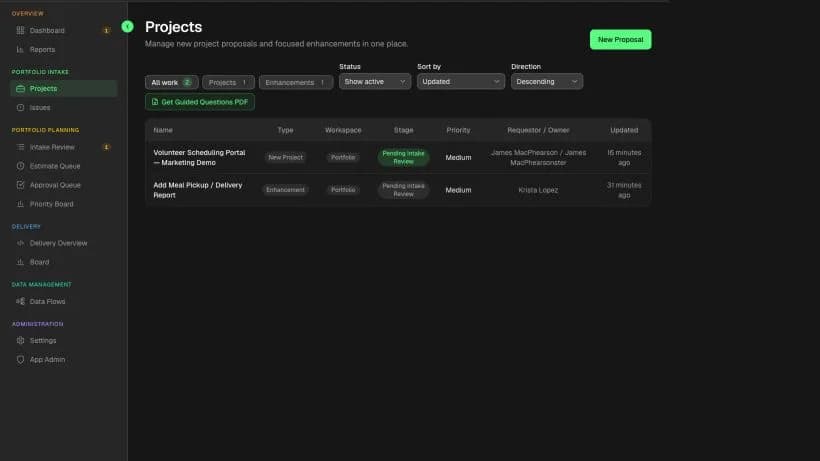
A tester who can only open a work-item description is verifying a paraphrase. The screenshots show the alternative: keep the submission and the reviewed requirements on one record, then let any Jira epic point there.
Foundry submission
Jira-ready epic
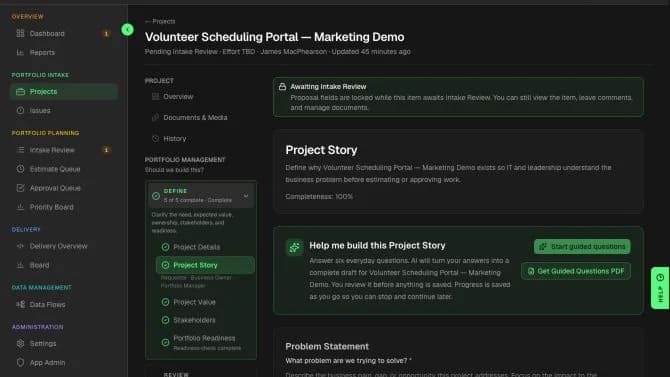
Jira-ready sprint epic
Pointer to the Foundry thread—not a paste of the intake form into a Jira description.
If engineering must sprint in Jira, create one Epic for the approved Foundry delivery record and paste the stable Foundry link into that Epic. Child stories and tasks can stay in Jira without separate Foundry links.
This is the manual handoff model. Foundry holds the living request. One Jira Epic carries the stable pointer; engineering manages its child work in Jira when Jira owns execution.
What the Jira epic should inherit—not retype
Jira epic field
Epic summary and reporter
What survives
The person closest to the problem stays visible
Jira epic field
Epic description as a pointer, not a rewrite
What survives
QA can open the original words
Jira epic field
Sprint commitment only after the recorded yes
What survives
Training and adoption are not dropped at the paste
Jira epic field
Linked acceptance / definition of done
What survives
Out-of-scope work does not appear as new tickets
Jira epic field
Child stories and tasks managed in Jira
What survives
Engineering derives child work from the reviewed requirements; each child does not need a separate Foundry link
| Foundry field | Jira epic field | What survives |
|---|---|---|
| Proposal name and requestor | Epic summary and reporter | The person closest to the problem stays visible |
| Business problem and first-release outcome | Epic description as a pointer, not a rewrite | QA can open the original words |
| Business and technical estimates | Sprint commitment only after the recorded yes | Training and adoption are not dropped at the paste |
| Named exclusions and constraints | Linked acceptance / definition of done | Out-of-scope work does not appear as new tickets |
| Reviewed business and functional requirements | Child stories and tasks managed in Jira | Engineering derives child work from the reviewed requirements; each child does not need a separate Foundry link |
Practical template
Use this as a pre-mortem on the last release. If a row lived in intake and died in the work item, testers never had a chance. Examples are fictional.
What QA can see when they only open the ticket
What the Jira ticket usually shows
A feature name: “status page.”
What QA then verifies
QA checks that a status field renders, not that staff can see a complete request through.
What the Jira ticket usually shows
A generic user on the story.
What QA then verifies
A public link ships because “user” was not staff-only on the ticket.
What the Jira ticket usually shows
Silence in Description.
What QA then verifies
Testers never fail the public page because nothing in Jira said it was out.
What the Jira ticket usually shows
A due date, or nothing.
What QA then verifies
Fall registration blackout never becomes a test condition.
What the Jira ticket usually shows
The reporter who filed the epic.
What QA then verifies
QA pings the developer. The coordinator who wrote intake is not on the issue.
What the Jira ticket usually shows
Acceptance criteria typed at planning.
What QA then verifies
Cases match the conversation in the room, not the answers that were reviewed.
What the Jira ticket usually shows
A comment on a random story.
What QA then verifies
Legal blocked client email. QA still fails a case the team already dropped—or worse, passes it.
| What the request had | What the Jira ticket usually shows | What QA then verifies |
|---|---|---|
| The requestor’s outcome sentence | A feature name: “status page.” | QA checks that a status field renders, not that staff can see a complete request through. |
| Who is allowed to see the result | A generic user on the story. | A public link ships because “user” was not staff-only on the ticket. |
| Named exclusions | Silence in Description. | Testers never fail the public page because nothing in Jira said it was out. |
| Hard constraints and busy seasons | A due date, or nothing. | Fall registration blackout never becomes a test condition. |
| The owner who can answer “what did they mean?” | The reporter who filed the epic. | QA pings the developer. The coordinator who wrote intake is not on the issue. |
| Reviewed requirement answers | Acceptance criteria typed at planning. | Cases match the conversation in the room, not the answers that were reviewed. |
| Later decisions on the thread | A comment on a random story. | Legal blocked client email. QA still fails a case the team already dropped—or worse, passes it. |
Worked example
A fictional Client Intake Portal was requested as staff-only complete submissions. QA received Jira stories for a status field and an optional public link. The board went green. The requestor rejected UAT.
A tester who passed the ticket and failed the requestor
What happened
Three Jira stories and the epic Description
What happened
The intake answers, the staff-only exclusion, or the owner’s name
What happened
Status field visible; public link optional; export “nice to have”
What happened
The tickets. The paraphrase was internally consistent.
What happened
A public link the business user had excluded, and no definition of “complete”
What happened
A green sprint against the wrong product. Retest against the original thread.
| Verification step | What happened |
|---|---|
| What QA was given | Three Jira stories and the epic Description |
| What QA was not given | The intake answers, the staff-only exclusion, or the owner’s name |
| What they tested | Status field visible; public link optional; export “nice to have” |
| What they passed | The tickets. The paraphrase was internally consistent. |
| What UAT showed | A public link the business user had excluded, and no definition of “complete” |
| The cost | A green sprint against the wrong product. Retest against the original thread. |
QA did the job they were handed. They were handed a copy. The fix is not more test cases on the ticket. It is giving testers the living request and treating any Jira issue as a pointer into that thread.
What QA opens today vs. what the business user wrote
What the business user wrote
Staff submit a complete request and see its status
What the business user wrote
Public self-service is later; staff-only is in writing
What the business user wrote
Reviewed answers about audience, completeness, and exclusions
What the business user wrote
The coordinator who can still explain what is broken today
| What QA opens today | What the business user wrote |
|---|---|
| A Jira description: “user can view status” | Staff submit a complete request and see its status |
| An optional public link on the story | Public self-service is later; staff-only is in writing |
| Acceptance criteria typed at sprint planning | Reviewed answers about audience, completeness, and exclusions |
| The reporter who filed the epic | The coordinator who can still explain what is broken today |
Access to tickets without access to intake is how verification becomes a closed loop on the copy.
A long description is still a paraphrase. Expected results should cite the reviewed answers, including what is out of scope.
The requestor should recognize their outcome sentence next to the build. If they only see Jira language, you have paraphrased them twice.
Internal consistency is not correctness. If the ticket and the request disagree, fail or park the story. Do not green-bar the copy.
In Precision Foundry
Precision Foundry is built so the QA tester verifying a release is looking at the exact same data thread the business user created during intake. There is no charter-to-ticket migration that testers then inherit. If engineering still sprints in Jira, the work item points at that thread instead of replacing it.
Common questions
Because that is the file they are given. Testers verify the document in front of them. If they can only open a work-item description, they confirm the paraphrase. They cannot see the business user’s answers, so they cannot catch that development implemented the handoff.
It is the bill for that paste, paid later. Copying intake into a backlog is the PMO moment. Testing the ticket is the QA moment. Different searcher, same split: the work item became the spec.
The same answers the business user wrote at intake, plus the reviewed requirements that followed. Use the Jira issue to find the build. Do not use its Description as the expected result.
Yes. Keep Jira if that is how engineering works. Put a stable pointer on the epic to the living request, give QA access to that thread, and fail the release when the ticket and the request disagree.
Because the organization invited them to the tracker and not to the source. Process trained them to treat the work item as official. Change the invitation, not only the test-case template.
Precision Foundry keeps this guide attached to the request so the template does not live in a forgotten doc.
Request Private AlphaOptional cookies
We use optional technologies only with your choice. Strictly necessary cookies for sign-in and security always run. Cookie Policy