
The goal stayed in the workshop
Leaders left aligned. The request arrived as a vendor name or a portal. Nobody can point at the outcome the build is supposed to serve.
Business-IT alignment
Alignment is not a strategy offsite. Write the business goal on the software request, size both sides of the change, record a yes against that goal, and keep the original outcome attached through requirements, the sprint, and testing.
For department managers, finance partners, and IT leads who keep funding software that never traces back to a written business goal.
Technology is aligned when
A strategy offsite, an OKR cascade, or a steering slide can name a goal and still leave IT building a slogan. How to align technology with business goals is a software-investment problem: the goal has to live on the request that later becomes requirements, a sprint, and a test. If the outcome only exists in a deck, delivery will invent a different one.
Leaders left aligned. The request arrived as a vendor name or a portal. Nobody can point at the outcome the build is supposed to serve.
Story points sized the code. Training, process change, and the people who have to hit the goal were someone else’s later problem.
Capacity went to the loudest sponsor. The written goal, if it existed, was not the thing that got funded.
Do not start with another alignment workshop. Start with one software request that carries the business outcome, both estimates, and a recorded decision. This is how you align technology with business goals on software change—not how you write a five-year IT strategy.
Write the business outcome first in software project intake, so the goal exists before anyone estimates a system or books a steering review.
Keep that outcome attached in requirements gathering software while the questions that would change the first release are still being answered.
Name the current path, who is stuck, and what better looks like. A system name is not a goal.
“Staff can submit a complete client request and see status without emailing a spreadsheet” is a goal. “We need a portal” is a costume. If you cannot write the first sentence, you do not have alignment work. You have a slogan.
Alignment needs a reachable owner on the business side, not a steering committee as the author.
The person closest to the broken week writes it. A reviewer checks whether a stranger can retell the outcome. A sponsor can fund later. They should not rewrite the week into a strategy noun.
Put business effort next to technical effort on the same request. A development quote is not alignment.
The build can be honest and still miss the goal if training, procedure change, and first-month support are invisible. Pair the numbers before anyone treats a sprint date as a commitment.
Compare software investments against budget and capacity. Record what the yes displaces.
A high score that ignores remaining funds is not a decision. Alignment means this goal used the remaining capacity, and another request waited, on the record.
Questions, answers, and the first-release boundary stay on the same thread as the goal.
If discovery starts from a blank template, the workshop goal is already gone. Carry the outcome forward. Park work that would change the goal. Do not let a later ticket invent a new one.
QA should still be able to open the original outcome when the increment ends.
If testers only see a Jira summary, you aligned a board to itself. The recorded yes is the acceptance test: did the week get better for the people named on the request?
Practical template
Use this on a single software request. Blank rows are how a strategy slide becomes an unrecognizable build.
Business-IT alignment checklist for one software change
Why it matters
A stranger should be able to retell what better looks like without a meeting.
Example
Staff submit a complete client request and see status; public self-service is later.
Why it matters
Follow-up questions need a name. A steering committee cannot sit in discovery.
Example
Operations lead who still runs the Friday spreadsheet workaround.
Why it matters
If you cannot name who is stuck, the goal is a slogan.
Example
36 intake clerks and 6 supervisors; finance reviewers are out of scope.
Why it matters
Build hours without rollout hours are a half-plan.
Example
Technical cutover plus training, coverage, and first-month support.
Why it matters
A hallway blessing spends capacity without citing the goal.
Example
Yes for staff submit-and-track this quarter; public portal waits.
Why it matters
Hidden extras are how an aligned goal becomes a different product.
Example
Historical import and a public status page are later increments.
Why it matters
A new document pile is where the goal goes to die.
Example
Questions about exceptions stay on the original request.
Why it matters
A closed ticket is not proof the business goal happened.
Example
QA opens the request, not only the story summary.
| Check | Why it matters | Example |
|---|---|---|
| Written business outcome | A stranger should be able to retell what better looks like without a meeting. | Staff submit a complete client request and see status; public self-service is later. |
| Reachable business owner | Follow-up questions need a name. A steering committee cannot sit in discovery. | Operations lead who still runs the Friday spreadsheet workaround. |
| Named people who feel the goal | If you cannot name who is stuck, the goal is a slogan. | 36 intake clerks and 6 supervisors; finance reviewers are out of scope. |
| Paired estimates | Build hours without rollout hours are a half-plan. | Technical cutover plus training, coverage, and first-month support. |
| Recorded yes, no, or not yet | A hallway blessing spends capacity without citing the goal. | Yes for staff submit-and-track this quarter; public portal waits. |
| First-release exclusions | Hidden extras are how an aligned goal becomes a different product. | Historical import and a public status page are later increments. |
| Same-thread requirements | A new document pile is where the goal goes to die. | Questions about exceptions stay on the original request. |
| Test against the original week | A closed ticket is not proof the business goal happened. | QA opens the request, not only the story summary. |
Worked example
Leadership said “align intake with our client-experience goal.” IT heard “build a portal.” The numbers below are illustrative. The point is the record, not the dollars.
Worked example: a fictional client intake goal
Value
Staff can submit a complete client request and see status without emailing a spreadsheet
Value
Public self-service, historical import, mobile app
Value
Intake operations lead who still runs the Friday workaround
Value
Training, coverage, and first-month support for 36 staff and 6 supervisors
Value
Submit-and-track path, identity already in place, no data migration
Value
Yes this quarter; the public portal waits because capacity is already spoken for
| Alignment input | Value |
|---|---|
| Written goal | Staff can submit a complete client request and see status without emailing a spreadsheet |
| Explicitly out | Public self-service, historical import, mobile app |
| Business owner | Intake operations lead who still runs the Friday workaround |
| Business estimate | Training, coverage, and first-month support for 36 staff and 6 supervisors |
| Technical estimate | Submit-and-track path, identity already in place, no data migration |
| Recorded decision | Yes this quarter; the public portal waits because capacity is already spoken for |
The portal was never the goal. Alignment happened when the written outcome, both estimates, and the no to the public page sat on one request—and testers could still open that sentence at release.
Workshop alignment versus a recorded software yes
A recorded software yes
A request that names the broken Friday and the first-release outcome
A recorded software yes
Both estimates sit on the same record as the goal
A recorded software yes
A yes that cites capacity and what waits
A recorded software yes
Requirements stay attached to the original outcome
| A strategy offsite | A recorded software yes |
|---|---|
| A slide that says “improve client experience” | A request that names the broken Friday and the first-release outcome |
| IT leaves “aligned” and estimates a portal | Both estimates sit on the same record as the goal |
| A steering blessing with no named no | A yes that cites capacity and what waits |
| Discovery starts from a blank template | Requirements stay attached to the original outcome |
People can nod in a room and still fund a different system on Monday. The decision is the recorded yes on the request.
An annual objective is not a first-release boundary. Translate the goal onto one change, or IT will invent the product.
Dropping agile jargon helps people talk. It does not attach a funded outcome to the build. That is a later, separate job.
Once stories replace the request, testers verify the ticket. The business goal is already gone.
In Precision Foundry
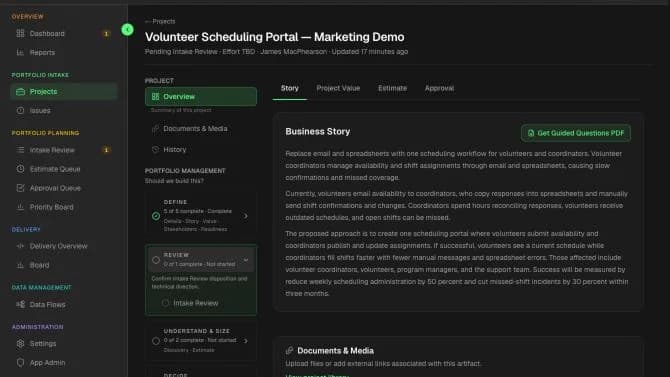
Precision Foundry is software delivery management for one job: a software change that still remembers why it was funded. The original outcome, both estimates, the recorded yes, and the questions a QA tester can still open stay on the same data thread from intake through delivery.
Common questions
Write the business outcome on the software request. Size business and technical effort together. Record a yes, no, or not yet against that goal. Keep the original outcome attached through requirements, the sprint, and testing. A strategy offsite is not the alignment.
No. A committee can rank themes. It cannot write the week, pair both estimates, or stay attached to the test. Use the committee to record the funding call on a complete request—not to author the request.
No. A strategy or OKR names direction. How to align technology with business goals, here, means one software investment still traces to a written outcome. Keep the annual objective where it lives. Do not treat it as a brief.
Stakeholder alignment is the language job: people can talk without a glossary. This page is the investment job: the funded software still serves the written goal. You need both. They are not the same page.
When a stranger can retell the outcome, both estimates exist, a recorded yes cites that boundary, and the first-release exclusions are written. Then software project planning can sequence the work. Not before.
No. A model can draft follow-ups. People remain responsible for the outcome, the estimates, and the funding call. An unreviewed draft is not alignment.
Precision Foundry keeps this guide attached to the request so the template does not live in a forgotten doc.
Request Private AlphaOptional cookies
We use optional technologies only with your choice. Strictly necessary cookies for sign-in and security always run. Cookie Policy